Tuesday, September 16, 2008

Harike Pattan bird sanctuary at Taran Taran Punjab offers a joy of lifetime

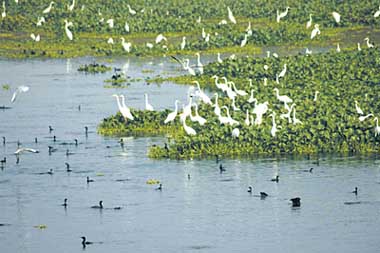
Harike wetland in Punjab’s Taran Taran District is the second largest bird sanctuary of India. It’s home to rare varieties of avifauna arriving here from different parts of Europe and northern Asia for stay during a major part of the year. About 60 kilometres from Amritsar, it is one of the largest freshwater wetlands in north India and is spread over 93 square miles. Of the total expanse of the wetland area of Harike Pattan, 26 square miles is open water.

Harike Pattan presents an inspirational example of nature conservation by authorities and non-government organisations. A visit to Harike Pattan bird sanctuary showcases how the golden wealth of nature exists here in its divine glory, untainted and undisturbed. And, why there is need for it to remain like that.

A few non-government agencies have now come forward for the conservation of some precious ecologically important habitats and spread public awareness among locals here.

During autumn, spring and winter, Harike Pattan turns a shelter for hundreds of species of birds. It is strategically situated for birds migrating to and from central Asia and Siberia.

It is one of the ancient confluences where the rivers Satluj and Beas converge. It's a quite sacred place. The confluence has been developed among the world's top 10 centauries. It is one of the largest wetlands of India and for centuries it has been home to migratory birds. The people of Punjab are familiar with these birds, as they are the best friends of children.

The sanctuary came into existence with the construction of a barrage at the confluence of the river Beas and Satluj for water storage and providing irrigation and drinking water. In 1978, the Punjab government declared the water-based body a wildlife sanctuary.

Punjab Tourism News by Sikh Tourism

Friday, September 12, 2008

Hazur Sahib, Nanded readies to receive Sikh multitudes for Gurta Gaddi Diwas

Hazur Sahib
Hazoor Sahib
With the historic day less than two months away, massive preparations are afoot to prepare for the multitudes of Sikhs that would throng this historic religious town for the Tercentenary celebrations of the Guruship of Guru Granth Sahib. Situated on the banks of the Godavri, the fourth Takht of the Sikh nation at Nanded is gradually sprucing up to welcome the sea of humanity that is likely to reach here on or around October 20 to celebrate a concept unparalleled in the religious history of the world. All religions have their scriptures and all are sacred. The Sikhs are blessed with having their Guru – their World Teacher – with them all the time. Sikhs will celebrate the unique bestowing of Guruship to the Word of the Gurus by the tenth Master, Guru Gobind Singh, in 1708 at Nanded, before he passed away.

Around the main Gurdwara and the famous Baba Nidhan Singh Langar, cleanliness on the streets and in the inn and the outer façade of the Langar Sahib is noteworthy.

Though there is no sarovar surrounding the main Gurdwara like Darbar Sahib Amritsar, the new periphery of Huzur Sahib now has some architectural resemblance to the housing complexes that surround the Golden Temple. The resplendence and glory of the neighbourhood is gradually getting a sheen though the roads and other infrastructure leading to the main sanctum sanctorum, the road outside the railway station and the airport are still to be completed. The Takht management committee expects all preparations to be finalized before the D-day.

In twenty villages around Nanded, tents with basic hygiene and sanitation facilities are being set up by the Maharashtra government. The Takht Management Committee has also built more inns and rest houses for visitors from India and foreign countries.

Around the historic Gurdwaras of Nanded, all efforts and activities are by the Sikh Sangat. The organization of tours and travels is also by the Sangat themselves. Except for some roads which are being rebuilt, which in any case is the responsibility of the state, there was no visible evidence of any significant expenditure by the state or central government, the SGPC or DSGMC. As in the case of all centennial celebrations of the Sikhs over the last decade, as far as these organizations are concerned, Sikhs largely feel there will be some uproar for a week and then it will be back to mundane basics.

Kar Sewa Babas are making military style preparations for the Langar as they expect to feed lakhs of people during the course of the celebrations. Langar utensils are being purchased in thousands and a fleet of volunteers are being pressed into the gigantic task.

Guru Gobind Singh’s clarion call in 1708 was unmistakably clear: “Agya Payi Akal Ki, Tabe Chalayo Panth, Sabh Sikhan Ko Hukam Hai, Guru Manyo Granth.” – By order of the God Almighty, the Khalsa Panth was formed. It is a diktat to all Sikhs that henceforth your Guru is only the Granth. This call and its deeper meaning have rattled many religious thinkers and the concept of the Word as the Guru has still to be appropriately explained by the Sikhs to the world.

The last days of the tenth Master, Guru Gobind Singh was spent at Nanded and when the Sikh world would celebrate the Guruship of Guru Granth Sahib, it would also recall the anniversary of the passing away of the Tenth Master. The consciousness of the Sikh people to revere the teachings as enshrined in Guru Granth Sahib and which teachings are not only that of the Sikh Gurus but also other religious leaders of the Bhakti movement and even before has brought them in confrontation with many pseudo-movements within the Sikh fold and outside it -which do not adhere to this doctrine. Forces attempting to undermine the distinctness of Guru Granth Sahib abound but a very large section of the community continues to have abiding faith in it as a living embodiment.

As usual and as expected, I could not find any literature in Punjabi, English, Hindi or the local language Marathi inviting the Sangat to the Takht or telling the visitor the significance of the coming occasion. The 300-Saal–Guru de Naal T shirt was omnipresent everywhere in the stalls all along the promenade outside the Takht.

Abchalnagar incorporates the land of some forty villages donated two centuries ago by the Nizam of Hyderabad -Sikhandar Jah to the Sikhs in gratitude of the support given to him by the Sikh armies of Maharaja Ranjit Singh. Very little of that land remains as a majority of it has been frittered away by a lackadaisical and short-sighted management committee whose custodians have invariably failed to protect the interests of the Sikhs under temptation of pecuniary gain and leadership and political pressure of the local government.

The destruction of the heritage sites-the Ramgharia Bunga and the Baradari alongside the Takht Sahib Gurdwara, the need for upkeep and maintenance of all the historic Gurdwaras in around fifty kilometer radius of Takht Apchalnagar Huzur Sahib, the complete rehabilitation of those families who have been uprooted from their home and hearth to make way for expansion plans, the democratization of the management set-up of the Takht and the poverty of the local Sikhs were stark realities one finds difficult to ignore. One also hopes that with such huge focus on the celebrations, the various management committees and voluntary organizations the world over would not continue to ignore this aspect once the celebrations are over.

After 300 years with the Guru, there should be no need left for the community or any of its individuals to indulge in self-pity. The community needs to stand tall, capable and strong and be counted amongst the comity of nations. If the Sikh nation does succeed, the objective of spending millions at Nanded would have been achieved.

Saturday, September 06, 2008

Enabling devotees at Dera Baba Nanak to catch a glimpse of Kartarpur Sahib gurdwara in Pakistan

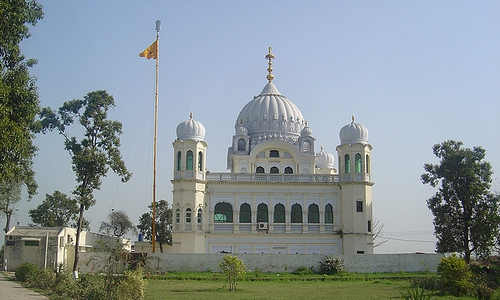
In order to facilitate devotees at Dera Baba Nanak to catch a glimpse of the historical Kartarpur Sahib gurduwara in Pakistan located in Narowal district, the BSF has constructed a beautiful viewing area.
Located on the banks of the Ravi, the gurdwara is at the place where founder of the Sikh religion Guru Nanak Dev (1469 -1539) spent the last years of his life as a humble farmer. Interestingly, the gurdwara is just 4.5 km away from the viewing point and is clearly visible with the naked eye on clear days. Besides, the personnel at the border observation posts too are helpful and willingy to lend their binoculars to the devotees who cannot afford to visit the place.

Over the years, the demand to have a corridor to the shrine has gathered momentum. Even Prime Minister Manmohan Singh reiterated his desire to have a corridor to the holy place so that devotees can visit it without any restrictions.

Talking to The Tribune, Baba Sukhdeep Singh Bedi, who claims to be a descendant of Guru Nanak Dev, said he had shouldered the responsibility so that sangat could offer prayers easily. Earlier, the devotees had to sit at the Dhussi Bandh and there were no facilities of any kind at that place. The conditions used to worsen in case of inclement weather, he pointed out.

He said the viewing area comprises a spacious cabin for visiting dignitaries and a roofed stand for general public. In addition to it, binoculars would be provided to the visitors so that they can have a closer look. Funding had never been a problem since devotees have offered their help regularly. All the material had been procured keeping the aesthetic beauty of place in mind, Bedi added. The BSF officials said they tried their best to help the devotees and had improved the road network in the area with the help of Border Area Development Funds. An official said when the BSF told the Pakistani Rangers that some trees block the view of the historic gurdwara from India’s side, the later pruned those trees to give a better vision.

Tuesday, September 02, 2008

World's first Sikh University to come up at Fatehgarh Sahib in Punjab

Fatehgarh Sahib, Punjab, is a holy town for Sikhs, where two sons of the 10th Sikh Guru, Gobind Singh, attained martyrdom in the 18th century, is set to be home to the first Sikh university - the Sri Guru Granth Sahib World University.

Punjab Chief Minister Parkash Singh Badal will Monday lay the first stone of the foundation monument - the 'Minar-e-Ikonkar' (Tower of God is one) - in this historic Sikh holy town, around 60 km from Chandigarh.

The university, spread over 84 acres given by the Shiromani Gurudwara Prabandhak Committee (SGPC), is coming up in an year which also marks the 300th anniversary of the 'Gurgaddi' (installation) of the Sikh holy book, Guru Granth Sahib, at 'Harmandar Sahib', the holiest of Sikh shrines, in Amritsar. Though founded with traditional values espoused by the Sikh religion, the university will deal with contemporary issues like the authentic interpretation of Sikhism in the modern context and idiom, role of Sikhism in the making of the 21st century society and the third millennium civilization, a state government spokesman said.

It also aims at addressing contemporary problems of Sikh identity vis-a-vis forces and processes of globalisation, facts about the Sikh diaspora and role of Sikhism and global interfaith dialogue, he added.

Sikhism is one of the youngest religions in the world, founded by the first Sikh guru, Nanak Dev, in the 15th century. The Sikhs, considered one of the most progressive communities, traditionally hail from the north Indian state of Punjab.
Besides the routine courses in arts, science and other fields, the university will focus on emerging technologies such as bio-technology, nano-technology, information technology and disciplines like ecology, human rights, feminism, empowerment of the down-trodden and other related spheres.

To give the university a 21st century outlook, it is looking at multi-national companies and other international universities for tie-ups. The spokesman said that arrangements will be made with foreign universities to enable scholars of Sri Guru Granth Sahib World University to be sent abroad as part of the course study.

Regional and overseas extension centres of the University will be established in India, North America, Europe, Southeast Asia and other countries wherever Sikhs and Sikhism have reached.

The university authorities are also planning to rope in the Sikh diaspora in the new venture.

The university also gives the students an option to undertake advanced studies in Sikhism - its philosophy, ethics, relation with other religions, history, music, linguistics, holy shrines and historical places associated with the religion, architecture, paintings, way of life, martial arts, diaspora and role of Sikhism in the 21st century.

Sunday, August 31, 2008

Film Sat Sri Akal – a story of love and faith

Slated for release in the last week of September, Sat Sri Akal –a story of love and faith, is a cinematic contribution for the Tricentenary Gurta Gaddi celebrations.

Are cinema characters to serve as role models? Is eulogizing a Sikh achiever in the field of music and cinema tantamount to preparing Sikhs for a stint in Bollywood? Well, the times are changing and changing fast. Sometime back, we were yearning for a radio station at Darbar Sahib, now we are looking at setting up a regulatory authority to monitor the plethora of channels blaring religious untruths and falsehood.

Not very long ago, we wanted “good Sikh characters” in Bollywood and Hollywood. If a young Ishmeet Singh or Manpreet Singh chooses to have acting as a career and their visibility happens to be more, much to the chagrin of those who don’t like Sikhs in cinema, it is certainly not their fault. Neither Manmeet Singh nor Manpreet Singh goes around town exhorting young Sikhs to join films. Some of these young people are doing yeoman’s service besides their careers and that needs to be appreciated.

With the fully bearded and turbaned Manpreet Singh as the lead hero, Sat Sri Akal will foster renewed interest in the Sikh face. Whatever happens, Bollywood will have to sit up, listen and take notice. In the years to come, it will become more difficult for them to malign Sikhs as they have doing for all these years.
In this historic year of the Sikh calendar, Sat Sri Akal will be a much talked about movie, because it puts on celluloid the true strains of Sikhism, the ethos of faith in Guru Granth Sahib and the importance of tradition and values in modern day life. The protagonists, the Mata Tripta Ji Charitable Trust, Chandigarh have been working hard to ensure that the movie reflects the spirit of Sikhism. Shot on location at Darbar Sahib and Hazur Sahib, the producers say that the film “literally symbolizes and implies truth, divinity and cheer in true harmony.” Interestingly, it is based on a true story and though it has Sikh characters and a Punjabi background, it has a universal appeal.

The cast and crew is essentially Punjabi and the writer Arvinderjit Singh has spared no effort to encapsulate Punjabi culture, moral values and Sikh tenets. The music of the movie also has the Punjabi touch with a string of percussion instruments and singers like Jagjit Singh. Among the Shabads in the movie, there is Dithe Sabhe Thaav, sung by late Ishmeet Singh, much before he became the Voice of India.

With the marketing support of Frankfinn Entertainment co, the film is likely to go worldwide and with the Diaspora interest in Sikh characters gradually increasing, the film is set to attract much-deserved attention.

Sikh News by Sikh Tourism

Thursday, August 28, 2008

Hotel Ramgarh Fort near Chandigarh has tallest Door in country


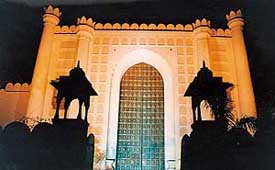
It is official. The door of the Fort at Ramgarh is the tallest door in the country higher than even the gate of Fatehpur Sikri near Agra. The latest edition of the Limca Book of Records which is the Indian equivalent to the Guinness Book of Records, lists the entry of the “tallest door” at page number 204.

The wooden door guarding the 350-year-old Ramgarh Fort near Chandigarh measures 37ft in height and 14½ ft in width.

The “Buland Darwaza” at Fatehpur Sikri stands 120 ft tall, including the steps and the constructed area but the actual door is only 23 ft. The door at the Bathinda fort in Punjab is 26 feet high.

Interestingly, the doors of forts and palaces were kept exceptionally tall in previous centuries so that the rajas sitting on elephants could enter without dismounting. Hence they were often called hathi deorhi.

The door of the fort is a replica of the original door, which was built 300 years back by the Chandel Rajput dynasty but broken during the 1857 mutiny. The replica was reconstructed in late 1980, by Kanwar Mohan Singh, a scion of the former ruling family of Ramgarh, is now a part of the premises converted into a heritage hotel. Each of its two panels weighs 21 quintals despite which, it can be easily closed and opened. About 2000 man-days were spent in putting the new door together with 343 custom-made copper plates and 343 spikes on it.

Spikes were used on the doors in olden days so that these could not be broken by an attacking army with the help of elephants banging their heads on it.

Tuesday, August 26, 2008

Negotiations to Purchase Historic Gurdwara Baoli Sahib at Jagannath Puri in Orissa

Gurdwara Baoli Sahib at Jagannath Puri in the state of Orissa, where Guru Nanak unearthed a natural spring and where he sang the shabad ‘Gagan mae thaal rav chand deepak banay, Taaraka mandal janak moti...’ that challenged the concept of aarti, is a rather miserable looking place.

Like many other Sikh historic places, Gurdwara Baoli Sahib is desperately in need of conservation.

A painting of Guru Nanak languishing in the gurdwara shows the Guru sitting under a tree with his two sons sitting to his right, and his companion, Mardana, playing the rabaab, also to his right. When I saw it in February, it was in very sad condition.

The decrepit baoli, a stepped well that goes down to the water surface, marks the spot in the sand where Guru Nanak dug his staff to release a spring of sweet water, the only source of drinkable water in the area.

The gurdwara is very small. There are two rooms, one for Guru Granth Sahib and the other for Lord Jagannath. The caretaker priest does both Sikh and Hindu prayers.

About a mile from Gurdwara Baoli Sahib stands a newer gurdwara, Nanakmata Sahib, which was built less than 10 years ago. It has 24-hour open langar and a building next door for travelers to stay.

There is also a lot across the road, just in front of the gurdwara, large enough to build three homes. It was donated to the gurdwara by the city of Puri. Gurdwara officials said they were planning to build a children’s park and a library named after one of the Panj Piaray, Mohkam Singh, who was from Puri.

Puri does not have any Sikh resident, but the sangat regularly goes to Gurdwara Nanakmata Sahib from the neighboring state capital of Bhubaneshwar and from the city of Cuttack.

Gurdwara Nanakmata Sahib is working with the Shiromani Gurdwara Parbandhak Committee to take possession of the old historical Gurdwara Baoli Sahib. Its secretary said the government and the Brahmin family at Baoli Sahib had agreed, in principle, to hand it over, at an agreed price.

When that will happen is not known, but hope the Baoli Sahib family is given millions of rupees for their seva and for passing the responsibility of the gurdwara on to the Sikhs.

Jagannath Puri, on the shores of the Bay of Bengal, is one of the four most sacred places of pilgrimage for Hindus. A special ritual, called aarti, is performed in praise of Lord Jagannath, Lord of the universe. Aarti worship involves circulating a metal platter on which little lamps with butter-soaked wicks are lit.

Guru Nanak watched pilgrims doing aarti at Jagannath Puri during his odyssey in the mid 1500s. He did not participate. Instead, he sang a shabad about the true realm of Waheguru, in which aarti is meaningless.

Sunday, August 24, 2008

Punjabi Jutti no more a popular wear


Punjabi Jutti was known for its immaculate embroidery and varied hues which made it a popular wear for the people of the region for all types of occasions.But today it appears to be on its way out in absence of any government support and in face of fashion trends which are too fast-paced for the practitioners of this trade to keep abreast of, almost bringing down curtain on this century-old tradition.

A survey revealed that this handicraft business are fast shrinking. The Punjabi Jutti market near the Quila Mubarak in Patiala, which once enjoyed an enviable reputation for this trade, is finding the old hands there no more keen on this craft. Thousands of families involved in making these Jutti since 19th century are unable to earn enough to keep their body and soul together and are feeling compelled to bid adieu to their trade.

“The Jutti was in a great demand in early 60s and 70s, but 90 onwards, there was a decline in its popularity. Due to new trends in fashion, it was no more a daily wear. Although we tried our level best to keep pace with these trends, but due to lack of enough funds at our disposal and frequent changes in fashion, we failed to cater to the need,” revealed some of the families involved in the trade said.

Apart from this, the new taxes on the raw material like leather has further tightened the noose around this business. Earlier, there was no tax on leather, but now it has been brought under the ambit of Vat, thus leaving the makers of these Jutti with no option but to bow out. Earlier, this business was allowed some subsidies too. But now with subsidy gone and on the top of it extra levies slapped, the margins have come down drastically.Revealed the owner of Punjabi Jutti House, Jagdish Kumar, “Earlier, one shopkeeper used to have a nearly Rs 3-5 lakh turnover every year, but now it has come down by 70 pc and our commerce with various distributors from Delhi, Gurgaon and Bombay has also declined.”

‘Each one, Teach one’ - It’s learn & teach in Punjab college

One minute, they are students trying to absorb as much of the lesson as possible. The bell goes and they slip into a different role — that of teachers. In Gurdaspur’s Baba Aya Singh Riarki College for Women, ‘each one, teach one’ isn’t just a saying; it’s the college code. So, seniors teach juniors, set question papers for them, distribute answersheets and ensure that the exam goes off smoothly. Sans invigilators, mind you. For copying is unheard of in this institution established in 1967, with the aim of educating girls.

"The first time in front of a class is daunting but now I lecture confidently," says 18-year-old Harpreet Kaur, a econdyear BA student who teaches first-year students. All disputes are also resolved by the students themselves to boost their problemsolving skills.

Not just teaching, everything here is inhouse. Students cook, wash clothes and clean the campus, eliminating the need for any staff. Enter the building, and it is difficult to distinguish teacher from the taught, cook from sweeper. Clad in white salwar-kameez with heads covered in white dupattas, students rotate duties as teacher, cook and sweeper. The principal’s wife, Jagdish Kaur, oversees all kitchen activities.

"In our institution, the annual expenditure for a day scholar is Rs 800 and Rs 6,000 for a boarder," says octogenarian Swaran Singh Virk, who besides being principal is administrator, guide and mentor for students. Presently, the hostel accommodates about 2,000 students.

The college also has its own flour mill, saw mill and cane-sugar grinder, dairy farm and even a biogas plant that supplies gas to the kitchen, thereby saving at least Rs 1,000 a day. Use of solar power also helps cut their energy bill by a further Rs 10,000 per year.

The extra income goes towards educating kids who can’t afford to pay even the Rs 800 annual fee, says Virk. Though it has no affiliation, Guru Nanak Dev University has established an exam centre here and evaluates answersheets.

And though self-sufficiency is the guiding principle behind this college, the results are proof that academics aren’t neglected. The pass percentage every year is 99-100%, with almost 80% getting first division.

Sikh Tourism introduces Punjab Village Tour


Sikh Tourism has introduced a new travel package "Punjab Village Tour" which will take you to Sikh Cultural, Religious, Rural & Heritage life of Punjab Cities of Patiala, Amritsar, Anandpur and Chandigarh along with darshan of Golden Temple, Anandpur Sahib and Gurudwaras of Delhi.

People have visited the cities of Chandigarh, Jalandhar, Ludhiana, Patiala and Amritsar but may not have seen the actual life of a lively Punjab. For a traveler, Punjab is a wonderful tourist destination and especially if your visit a countryside place or Pind (village)is what you wish to explore on your Punjab Village Tour, spend some in a traditional Punjab village.

During this tour, a traveller will be shown the actual daily life of a villager, given homemade food, could participate in the local works like carpentary, ploughing, cow milking, clay pottery, etc. They could also see the work being done on handicrafts like Phulkari, utensil making, wood work, etc.

For more details, see at http://www.sikhtourism.com/punjab-village-tour.htm

Friday, August 22, 2008

Punjab women getting into the world of glamour

Gone are the days when women in Punjab were simply sitting at home and looking after the family. They had always been known as looking after their health as well as their beauty, which distinguished them from other women of the country. They have made it big in various fields and gracefully topped the world of glamour. One after the other, Punjab has offered several women in the arena of fashion. They now serve as a role model for other women, who too wish to take some initiative to enhance their beauty. The beauty is very much in keeping with the latest trends. As for now it's that of coloured hair and the women of Punjab are very much a part of this fad.

"Punjab, in our opinion, is one of the most buoyant markets, when it comes to beauty products, when it comes to lifestyle oriented products. As you have people who are really very beautiful and want to enhance their beauty further. You have people who have disposable income and people having the intent to spend that money. It's a very important market for us. It's a fast growing market. In terms of per capita consumption of cosmetics, it's one of the highest in the country," said Vismey Sharma, director of beauty saloon chain.

Many believe that this sudden interest in beauty enhancement methods has a lot to do with the ongoing trend, which demands that a woman should look at her best, always. With the affect, Beauty awareness is growing in both rural and urban Punjab. To cater for the Punjabi girl's desire to look beautiful, parlours have mushroomed in smaller cities and even villages of Punjab. " The biggest benefit is that earlier the women (of rural Punjab) had to go to some big city like Chandigarh, but now it's (saloon) nearby and hence, saves a lot of money. One doesn't have to go to any other city every time," said Neena, from rural Punjab. All said and done, Punjab's women are out to be number one!

Wednesday, August 20, 2008

Corridor to Kartarpur Sahib Gurudwara could be another Indo-Pak CBM

Indian External Affairs Minister said that the building of a tarred corridor between the Dera Baba Nanak in India and the Gurdwara Kartarpur Sahib in Pakistan Narowal District, could serve as a possible confidence building measure between the two countries. Indian Minsiter was visiting Dera Baba Nanak at the invitation of Punjab Chief Minister to assess the feasibility of the corridor to facilitate pilgrims.

Indian Minister said it was necessarily to create a good relationship with Pakistan, as "We have already opened two routes with Pakistan and are ready to open more routes so that more people come and know each other, and remove existing misunderstandings."

The minister announced that the Indian Government would send a group of experts to conduct a feasibility study for the construction of the much in demand corridor from Dera Baba Nanak to Kartarpur Sahib. He said the team would submit a report to the government, following which the matter would be discussed with Pakistan. If Islamabad agreed to proposed project, it would be immediately implemented, he added. Mukherjee visit to the border was welcomed by various Sikh organizations.

Once the corridor was in place, Sikh devotees could enjoy a hassle-free sikh pilgrimage, instead of taking the circuitous journey via Wagah, Lahore and Narowal. The region would also experience heightened economic and sikh tourism activity as a result. Sikh pilgrims have been demanding a safe passage to the Gurdwara Kartarpur Sahib from Dera Baba Nanak for years.

Monday, August 18, 2008

Bidar Nanak Jheera Gurudwara, a beacon for devotees

Gurudwara Nanak Jhira Bidar is emerging as an important spiritual tourism destination. The Nanak Jhira Gurudwara here attracts hundreds of tourists every day. Every day thousand of devotees from across the country visit this gurudwara. Devotees believe that the first Sikh Guru visited Bidar on his way to Sri Lanka in March 1512. "Then, Bidar was a dry place with no source of drinking water. People were forced to use brackish water. The Guru moved a stone under his feet and an eternal spring of fresh water gushed out. The spring flows even today. People believe it has magical powers and cures diseases," says Amar Singh Ragi, the gurudwara manager.

Sahib Singh, one of the `Panch Pyares' of Sikhism, was born in Bidar. That is why it attracts devotees from far and wide, he says. The gurudwara trust runs a hospital and a free canteen for tourists.

`Nishan Sahib,' the flag of Sikhism, which is treated as a symbol of the gurus, enjoys a special place during the celebrations of Guru Nanak Jayanti. Every year, hundreds of flags are brought from various gurudwaras in the country. Devotees from Maharashtra and Andhra Pradesh walk along with the Nishan Sahib and take turns to carry it to Bidar. The faithful start reading sacred texts on the eve of Kartik Purnima. The chanting of songs and couplets goes on till 2.30 a.m., when firecrackers are burst to celebrate the birth of Guru Nanak. People take a dip at Amrit Kund, a small artificial pond in front of the gurudwara. They join in the singing of bhajans. Next day, they take out a procession in town.

"Bidar has come to be known as the Amritsar of the South and has become a compulsory stopover for Sikh tourists," says Bidar-based businessmen and gurudwara volunteer Manpreet Singh Khanuja. "It draws not only Sikhs living in different parts of the country, but also people of other faiths. The State Government needs to promote Bidar as an important tourist destination and provide more facilities," Mr. Khanuja said.

Bhagat Singh stands tall in Parliament

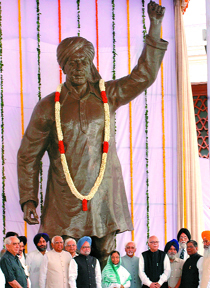
A statue of Bhagat Singh was unveiled at Parliament House, in New Delhi. Bhagat Singh made a grand reentry into the Indian Parliament this morning. Almost 80 years after he dropped the bomb in the Central Assembly Hall to “make the deaf hear,” the martyr came home to a warm and well-deserved welcome.

Heartening it was to see that he looked tall and turbaned, and every inch himself. The visit was, however, different from his last when, on April 8, 1929, he stormed Parliament to accomplish a revolutionary mission. At that time, he was sporting a hat to conceal his identity.

But today when President Pratibha Patil unveiled Bhagat Singh’s statue in courtyard number 5, his appearance was in consistence with his cultural identity. The turban and the smile were both in place.

“This, for us, is a historic moment that marks grand repetition of history after 80 years when Bhagat Singh first entered Parliament. We would have loved to see this day arrive earlier than 61 years of freedom. But that does not take away from it the happiness we feel.” said Kiranjit Singh, son of Bhagat’s brother Kultar Singh.

Also present were martyr’s nephews Abhay Sandhu and Zorawar Singh and his niece Verinder Sandhu, who has recently chronicled Bhagat’s life in her book, “Yugdrishta Bhagat Singh aur unke Mrityunjaya Purkhe.” “This day is precious for the nation,” Verinder told The Tribune, especially thanking sports minister M.S. Gill for the installation of the statue.

Ram Sutar, the creator of 18-foot bronze statue of Bhagat Singh, the sculptor behind the gigantic Mahatma Gandhi statue in Parliament complex and the Ranjit Singh statue in Amritsar’s Ram Bagh, Sutar could afford to let art do the talking. He was happy that his new creation would now share space with Indira Gandhi and Subhash Chandra Bose.

Interesting also is the fact that Bhagat’s statue is one among the only four to be donated by the Lok Sabha Secretariat; the other three being of Rabindra Nath Tagore, Vivekananda, and Aurbindo Ghosh.

Sikh news by Sikhtourism

Thursday, August 14, 2008

Sultanpur Lodhi in Punjab on the world religious tourism map

Sultanpur Lodhi will be the first place in Punjab to be on the world religious tourism map because of its sanctity and heritage value. This was disclosed by Chief Minister of Panjab. The CM also paid obeisance at Ber Sahib gurdwara on the occasion of the prakash purb of Guru Nanak Dev.

Representatives of the World Tourism Organisation had visited Punjab to identify places that have religious importance and Sultanpur Lodhi had been identified as a befitting place to be on the map. No place could hold more importance since this is where the Guru attained enlightenment, he pointed out.

At present, the Tourism Department is implementing a Rs 3.61-crore project to promote tourism in the Kapurthala - Sultanpur Lodhi tourist circuit and the ecological restoration of the Pavitar Bein project has been expedited. Keeping in view the religious value of this holy town, the government had initiated a series of steps to develop the city under the guidance of the newly constituted Sultanpur Lodhi Development Board. The infrastructure, health facilities and transport connectivity of this historic town would also be upgraded which would further boost sikh religious tourism.

Wednesday, August 13, 2008

Punjab heritage edifices being restored to boost tourism

The land of five rivers Punjab is also known for its grand history existing in its centuries-old forts, fortresses and Serais or, traditional lodgings created by the erstwhile rulers of Punjab. It's been always felt that these historical buildings hold a huge tourist potential, provided they are properly maintained. The Punjab Government, in collaboration with the United Nations' World Tourism Organization (UNWTO), has taken up the task of restoring heritage buildings for the promotion of tourism in the State. The restoration is being done by the UNWTO giving utmost attention to keep the original beauty of the heritage buildings intact.

For this mega restoration project, UNWTO has prepared a Master Plan and the Punjab and Central government are providing the resources including skilled artisans. The 'Shahi Samadhian' or the royal cremation ground is one of the many historical places in Punjab that are presently undergoing a makeover. Restoration work is also being done at the memorial or Samadhi of Baba Alla Singh, the founder of Patiala city.

The Punjab government wants to promote Amritsar, Kapurthala and Patiala as tourist destinations. The State government had earlier tied up with the UN World Tourism Organization to jointly promote Punjab as a global destination for religio-heritage tourism.

"The Golden temple is not the only Sikh heritage site in Punjab. There are lots of other places, which are overlooked. Lots of pilgrims go to Anandpur Sahib, which is wonderful. But just down the road is Kiratpur, which is very important from the point of view of Sikh heritage. It's a lovely little town having lots of lovely Gurudwaras, heritage gardens and so on. These places are missed since they are not publicized well enough. We want to emphasise those," an official observed.
If the princely state of Patiala boasts of the Sheesh Mehal and Bahadurgarh Fort, Kapurthala city is proud of its Jalaukhand fort. Besides majestic forts and palaces, there are historical Sikh shrines and edifices that attract tourists.

The Punjab government has listed 65 heritage sites to refurbish, out of which 12 are to be restored by the end of this year.

Tuesday, August 12, 2008

Gurudwara Nanak Shahi the main Sikh Gurudwara in Bangladesh

Gurudwara Nanak Shahi the main Sikh Gurudwara in Bangladesh, is situated on the campus of the university of dhaka near the arts faculty building. It is believed to have been built on the initiative of a Sikh priest, Almast, sent by the sixth Sikh guru, Hargobind Singh (1595-1644), during the reign of Emperor jahangir. Some others believe it was built by the ninth Sikh guru, Teg Bahadur Singh (1621-75), and that from here communication was maintained with other Sikh Gurudwaras in Bengal, Bihar and Orissa.

This shrine commemorates Guru Nanak's visit to Dacca. For some years in the recent past, the place had suffered neglect, and it was on the 2nd January 1972, after the liberation of Bangladesh, that Sri Guru Granth Sahib was installed again at the shrine. The room where the congregation met was 9 by 9 meters. Towards the left is an ancient tank, newly cleared of debris, with a baoli in its midst.

The Gurudwara was founded by a missionary sent to Bangladesh by Baba Gurditta, son of Guru Hargobing (6th Guru) within 17th century and was completed in 1830. Religious celebrations include weekly prayers every Friday. Social functions such as Baishakhi are celebrated. Old relics-an old handwritten volume of Guru Granth Sahib, a copy of the Portrait of Guru Teg Bahadur and Guru Teg Bahdur's sandals are preserved here Suitable accommodation is available for visitors.

Gurudwara Nanakshahi in Ramana behind the public library adjoining the Dacca University campus, was originally an Udasi Charan-Paduka founded by Baba Nath, successor of Bhai Almast, in memory of Guru Nanak Dev. When Guru Tegh Bahadur was at Dacca during the late 1660s, Bhai Nattha was the Udasi mahant and Baba Bulaki Das the Guru's masand here. On the eve of the Partition, possession and priesthood was the subject of court cases between Baba Tribeni Das and another claimant Gobind Das, and later between Tribeni Das and one Manik Lal. Ultimately Tribeni Das was adjudged the lawful guardian of the Gurudwara, but in the wake of the Partition, he left for India never to return. A Sikh, Swarn Singh looked after this place in his absence. After the creation of Bangladesh after Indo-Pak war, a Sikh deputation was sent from Takht Sri Patna Sahib to Dacca. With the help of Sikh soldiers the members of the deputation led by Captain Bhag Singh of Calcutta recovered possession of the Gurudwara, cleaned it and held a congregation in it on 2nd January, 1972. Even Sayyad Nazar-ul-Islam, then acting President of Bangla Desh attended the congregation and gave assurance about the safety and reconstruction of this and the other Gurudwaras.

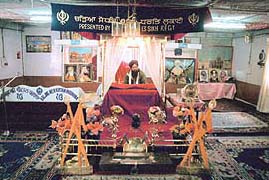
The Gurudwara is open to all, irrespective of race, religion, caste or sex. The place of prayer is known as 'darbar sahib' and has entrances on all sides, unlike other places of worship. At the northern end of the prayer hall a copy of the holy book of the Sikhs, the granth shahib, is kept on a wooden platform. A pair of wooden sandals, believed to belong to Guru Teg Bahadur Singh, has been preserved in a glass box just under the Granth Sahib.

The daily religious rites at the Gurudwara include reading from the Granth Sahib and recital of prayers. Every Friday a weekly assembly is held from 11 am to 1 pm. The chief granthi reads from the Granth Sahib. kirtan and prayers continue for over two hours. The prayer service ends with the distribution of food. There are also arrangements to distribute food in the morning. Sikhs regard this as a way of enhancing understanding among people. A weekly congregation is held by it in Gurdwara Nanakshahi, on every Friday, which is attended mostly by the devoted staff of the Indian High Commission, some Sikh devotees from the neighbouring lands and some devout Hindu residents of Dhaka.

There are also about eight or nine smaller Gurudwaras in different parts of Bangladesh. The Bangladesh Gurudwara Management Committee runs the affairs of these Gurudwaras with financial support from the devotees, foreign visitors, donors and grants from the Bangladesh government.

Sunday, August 10, 2008

Gurudwara Pathar Sahib, a major tourist attraction in Leh Ladakh

Built by Buddhist Lamas nearly five centuries ago to commemorate the visit of Guru Nanak, the founder of the Sikh religion, to Ladakh, the Gurudwara Pathar Sahib is visited by Hindu and Sikh devotees, besides tourists. Although the Ladakh's culture and religion is deeply influenced by Buddhism, the existence of Gurudwara 'Pathar Sahib' adds to the region's religious history and identity.


Legend has it that many centuries ago a demon had terrorised the people of Leh. Baba Guru Nanak, who visited the region around 1516 A.D, came to know about the problem and decided to bless them with his sermons. Locals welcomed him with open arms. His growing popularity angered the demon and in a fit of rage, he decided to kill Guru Nanak with sa large boulder. The boulder, however, turned into wax as soon as it touched Guru Nanak.


"Thinking the Sikh Guru must have got killed by the boulder, the demon appeared only to be shocked to find Guru Nanak Dev meditating. He pushed the boulder with his right foot, but as it had already melted into wax, his foot got embedded in it. Realising, Guru's enormous powers, the demon fell at his feet and sought forgiveness," said Rajender Singh, the caretaker of the gurudwara. Since then, resident Lamas revere the boulder and offer prayers to it. In 1948, the Gurudwara Pathar Sahib's maintenance was taken over by the Army.


The region has a sizeable Sikh population and devotees visit the site to have their wishes fulfilled.


"By the grace of God, my wish has been fulfilled. My younger brother, whose wish has also been fulfilled, has helped me take part in the `Akhand Path', a continuous reading of Guru Granth Sahib (the religious textbook of Sikhs). We have a great belief in Gurudwara Pathar Sahib," said Harjinder Singh, a devotee from Punjab.


Organize your Gurudwara Tours through
www.sikhtourism.com

Sikh athletes to don turbans at Olympic Games

Some Canadians might not agree with the notion of altering or adding to the national team marching uniform for an Olympic opening ceremonies. Yet after listening to Canadian field hockey player Ravi Kahlon's eloquent explanation, you at least understand the reasoning why he and three fellow Indo-Canadian players will wear turbans when marching into the opening ceremonies of the 2008 Summer Games on Friday.


The four players - Victoria's Kahlon, Bindi Kullar of North Delta, Gabbar Singh of Surrey and Ranjeev Deol of Mississauga, Ont. - don't wear turbans in everyday life and don't ever intend to. So why now, on this mammoth stage, with the world watching?


A turban is a Sikh religious symbol and in no way an Indian national symbol. Kahlon said as a Canadian he would never wear any symbol of Indian nationhood during the Olympics or at any international competition. This is no different than wearing a cross on your chest or a Jewish yarmulke during the opening ceremonies, which nobody would have any problem with," said Kahlon, an RBC mortgage specialist, and outstanding forward appearing in his second Olympic Games.


sikh news by sikhtourism

Friday, August 08, 2008

Delhi Gurudwaras build ramps, wheel in faithful

Delhi ramps are with a difference. They will not see style statements being made on them but will see the differently abled devout go right up to the threshold of the Granth Sahib. Stairs at places of worship are a problem for the elderly and the differently abled. Keeping this in mind, the Delhi Shiromani Gurudwara Prabandhak Committee (DSGPC) has begun a drive to make Delhi Gurudwaras easily accessible to all.

While the government is still planning to make offices and public places differently abled-friendly, the DSGPC has completed renovations on a second Gurudwara in the city. After Gurudwara Bangla Sahib, Nanak Piao in Azadpur has completed the construction of access ramps. Alongside the staircase, these green-carpeted ramps will help the wheelchair-bound and those who can’t climb steps.

With constant complaints coming in from devotees at Bangla Sahib, the authorities finally decided to take concrete steps. “A place of worship is for everyone and it is our responsibility to ensure that no one is denied the opportunity to visit the gurudwara. We did notice that a large number of the elderly and the differently-abled had to stop coming just because they couldn’t climb stairs. Besides constructing ramps, we have also made provisions for wheelchairs,” a Sewadar said.

Ever since the ramps were put in place, a number of devotees have been coming in wheelchairs. They are comfortably wheeled up by their family members.