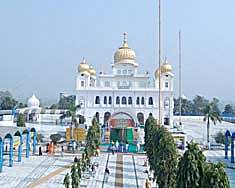
Hola Mohalla or Hola Mahalla or simply Hola is a Sikh festival that takes place on the first of the lunar month of Chet which usually falls in March. This, by a tradition estabished by Guru Gobind Singh, follows the Hindu festival of Holi by one day; Hola is the masculine form of the feminine sounding Holi. The word "Mohalla" is a Punjabi word that implies an organized procession in the form of an army column. But unlike Holi, when people playfully sprinkle color, dry or mixed in water, on each other, the Guru made Hola Mohalla an occasion for the Sikhs to demonstrate their martial skills in simulated battles.
Together the words "Hola Mohalla" stands for "mock fight". During this festival, processions are organised in the form of army type columns accompanied by war-drums and standard-bearers and proceeding to a given spot or moving in state from one gurdwara to another. The custom originated in the time of Guru Gobind Singh who held the first such mock fight event at Anandpur in February 1701.
The foothills of the Shivaliks in Ropar district of Punjab's north-eastern region, especially around the historic townships of Anandpur Sahib and Kiratpur Sahib, have, since 1701 been playing host to Hola Mohalla. Recently, the Indian government accorded it the status of a national festival. The military exercise, which was personally supervised by the guru, was carried out on the bed of the River Charan Ganga with the famous Hindu temple of Mata Naina Devi in the Shivaliks as the backdrop.
This annual festival held at Anandpur Sahib in Punjab and now replicated at other Gurdwaras worldwide was started by the tenth Sikh Guru, as a gathering of Sikhs for military exercises and mock battles on the day following the festival of Holi at Anandpur Sahib. It reminds the people of valour and defence preparedness, concepts dear to the Tenth Guru who was at that time battling the Mughal empire and the hill kings. On this three-day grand festival, mock battles, exhibitions, display of weapons, etc., are held followed by kirtan, music and poetry competitions. The participants perform daring feats, such as Gatka (mock encounters with real weapons), tent pegging, bareback horse-riding, standing erect on two speeding horses and various other feats of bravery.
There are also a number of Darbars where the Sri Guru Granth Sahib is present and kirtan and religious lectures take place. On the last day a long procession, led by Panj Pyaras, starts from Takhat Keshgarh Sahib, one of the five Sikh religious seats, and passes through various important Gurdwaras like Qila Anandgarh, Lohgarh Sahib, Mata Jitoji and terminates at the Takhat (Keshgarh).
For people visiting Anandpur Sahib, langars (voluntary community kitchens) are organized by the local people as a part of sewa (community service). Raw materials like wheat flour, rice, vegetables, milk and sugar are provided by the villagers living nearby. Women volunteer to cook and others take part in cleaning utensils and other manual tasks that need to be carried out. Traditional cuisine is served to the pilgrims who eat while sitting in rows on the ground. (Pangat)
The popularity of this festival may be judged from the fact that out of five Sikh public holidays requested by the Khalsa Diwan, Lahore in 1889, the Government approved only two - Holla Mahalla and the birth anniversary of Guru Nanak. Hola Mahalla is presently the biggest festival at Anandpur.
Together the words "Hola Mohalla" stands for "mock fight". During this festival, processions are organised in the form of army type columns accompanied by war-drums and standard-bearers and proceeding to a given spot or moving in state from one gurdwara to another. The custom originated in the time of Guru Gobind Singh who held the first such mock fight event at Anandpur in February 1701.
The foothills of the Shivaliks in Ropar district of Punjab's north-eastern region, especially around the historic townships of Anandpur Sahib and Kiratpur Sahib, have, since 1701 been playing host to Hola Mohalla. Recently, the Indian government accorded it the status of a national festival. The military exercise, which was personally supervised by the guru, was carried out on the bed of the River Charan Ganga with the famous Hindu temple of Mata Naina Devi in the Shivaliks as the backdrop.
This annual festival held at Anandpur Sahib in Punjab and now replicated at other Gurdwaras worldwide was started by the tenth Sikh Guru, as a gathering of Sikhs for military exercises and mock battles on the day following the festival of Holi at Anandpur Sahib. It reminds the people of valour and defence preparedness, concepts dear to the Tenth Guru who was at that time battling the Mughal empire and the hill kings. On this three-day grand festival, mock battles, exhibitions, display of weapons, etc., are held followed by kirtan, music and poetry competitions. The participants perform daring feats, such as Gatka (mock encounters with real weapons), tent pegging, bareback horse-riding, standing erect on two speeding horses and various other feats of bravery.
There are also a number of Darbars where the Sri Guru Granth Sahib is present and kirtan and religious lectures take place. On the last day a long procession, led by Panj Pyaras, starts from Takhat Keshgarh Sahib, one of the five Sikh religious seats, and passes through various important Gurdwaras like Qila Anandgarh, Lohgarh Sahib, Mata Jitoji and terminates at the Takhat (Keshgarh).
For people visiting Anandpur Sahib, langars (voluntary community kitchens) are organized by the local people as a part of sewa (community service). Raw materials like wheat flour, rice, vegetables, milk and sugar are provided by the villagers living nearby. Women volunteer to cook and others take part in cleaning utensils and other manual tasks that need to be carried out. Traditional cuisine is served to the pilgrims who eat while sitting in rows on the ground. (Pangat)
The popularity of this festival may be judged from the fact that out of five Sikh public holidays requested by the Khalsa Diwan, Lahore in 1889, the Government approved only two - Holla Mahalla and the birth anniversary of Guru Nanak. Hola Mahalla is presently the biggest festival at Anandpur.