sikh tourism offers travel to golden temple, hazur sahib, hemkund sahib, Sikh Pilgrimage, India Gurudwara Tours, Pakistan Gurudwaraa, Punjab Tours, Amritsar Tours, nankana sahib, panja sahib, paonta sahib, patna sahib, anandpur sahib, chandigarh package, amritsar hotels, chandigarh hotels, delhi hotels along with pilgrimage, holiday, study, business, incentive tours of Punjab and India
Monday, March 02, 2009
Hazi Rattan Dargah and Gurudwara, a symbol of communal harmony in Bathinda Fort
Sunday, March 01, 2009
Devotees offer toy plane at Gurudwara Talhan to go abroad
It all started a few months back, when the word spread that wishes of settling abroad would be fulfilled if one offered a toy plane at the shrine. On Sundays, about 40-50 planes are offered. In most cases, devotees who wish to fly to a particular country offer a toy plane of the airline of that country.
In Doaba region, where going abroad is dream of most people, a large number of people have an unshakable faith in the Gurudwara.
It has become a difficult task for the Gurudwara authorities to store so many toy planes. Punjabi youth, who dream of greener pastures abroad, come in large numbers after they hear stories of wishes of their friends to settle abroad being fulfilled after they offered planes at the Talhan Gurudwara.
"Whenever somebody's wish of going abroad is fulfilled, they come here at the Gurudwara to offer a plane. Punjabis from all parts of the world - England, America, Canada and many other countries come here," said one young devotee.
For the Punjabi youth, spending three to 10 dollars in buying a toy airplane hardly matters, if it increases the possibility of ultimately realizing a million-dollar dream.
Saturday, February 28, 2009
Gurudwara Kotha Sahib near Amritsar
And, about four miles from the holy city in village Vallah stands a magnificent edifice - Gurudwara Guru ka Kotha meaning Guru’s house.It is said Guru Tegh Bahadur, while leaving Amritsar, visited this village.
Legend has it that when Guru Tegh Bahadur visited the Golden Temple after becoming Guru, priests denied him entry. The Guru thereafter went to Vallah and was entertained by Mai Haro. Her house is where the gurudwara ‘Guru ka Kotha’ now stands. "When people of Amritsar came to know that Guru Teg Bahadurji was not allowed to enter the Golden Temple and he came to this place, they came here to take the Guru back. Guruji refused to go, but blessed the people saying that if people of Amritsar visited this Gurudwara during the fair on full moon day, they would remain happy.
Today, the holy place is visited not only by people from Punjab, but from all across the country," said Baldev Singh, the head priest of Gurudwara Kotha Sahib.
Every year, a large number of devotees throng the holy spot to celebrate the annual fair, held on the full moon day. The month-long fair that starts on February 6 is a unique example of ardent faith and devotion.
Born in Amritsar, Guru Tegh Bahadur was the youngest of the five sons of Guru Har Gobind. His father gave the name Tegh Bahadur meaning mighty of the sword to him for showing valour during a battle with the Mughals. During his young years Tegh Bahadur fought along his fathers’ side but after Guru Hargobind’s fierce and bloody battle in 1634 at Kartarpur, he turned to the path of renunciation and meditation.
Guru Tegh Bahadur’s 17-day stay at village Valla proved to be a blessing for the villagers.
"We come here every year to make wishes and all our wishes are fulfilled. People from all parts of the world come here to visit this gurudwara," said Baljinder Singh, one devotee. People visit this holy place irrespective of their caste or creed and set an example of brotherhood and unity. At the gurudwara, they enjoy the Langar or, community meal upholding the principle of equality.
Sunday, January 25, 2009
Sikhtourism introduces Punjab Village Tour under Punjab Rural Tourism
For a traveler, Punjab is a wonderful tourist destination and especially if your visit a countryside place or Pind (village) is what you wish to explore on your luxury Punjab travel, spend some in a traditional Punjab village.
Sikh Tourism has introduced Punjab Village Tour under Rural Tourism where it arranges accomodation, food and tour of a Punjab village.
What to See and feel in Punjab Village :
Early morning visit the houses to see and feel how the day in the village starts. Men give bath to their Cows and milk them. The ladies of the House will light their hearths with cow dung and leaves to cook food. The Punjab villager farmers plough their fields with bullocks.
Potters collect clay from nearby pond (Chhappar) and make clay pottery, Surahi and Ghara (vessels for storing water), dishes, jars, etc.
Sit and see the creative ability of the women in Phulkari embroidery of different design and blending of harmonious colours.
Watch village metal-workers or Lohars casting, soldering and making metal things like Hammer, Sickle, garden tools, pots and common utensils used in the village kitchen.
Visit Carpenters or Tarkhans to see them carving traditional and regional style Doors, Windows, Beds, chairs, tables, etc out of different Woods
You can walk along the swaying mustard fields, take a ride on a tractor, take the cattle for grazing, feed the cattle or simply sit, relax and gulp down the fresh buttermilk in the green fields.
For more details visit Sikhtourism webpage at
http://www.sikhtourism.com/punjab-village-tour.htm
Saturday, November 29, 2008
Gurudwara Angitha Sahib, Dehradun cremates old volumes of Guru Granth Sahib
Thus, such copies of Guru Granth Sahib are sent to Gurudwara Angitha Sahib where these are cremated with due respect.
The caretaker of Angitha Sahib does this cremation ritual as a sort of charity work. The entire procedure is performed in due privacy. "Scriptures from all across the world like England, America, Canada and Pakistan have come to Angitha Sahib in Sahaspur for getting cremated. With full respect, these holy epics are first given bath, and then they are wrapped in new clothes. Then these scriptures are treated like living beings. This service is done in privacy," said Harsharan Singh, Mukhya Sewadaar (chief helper), Angitha Sahib Gurudwara.
When old and worn out scripture reach Angitha Sahib in Sahaspur, first of all they are given bath after which every page is cleansed and later these scriptures are wrapped in white cloth and then the funeral takes place. The cremation lasts over six days and on the seventh day, the ashes are collected.
Caretakers and helpers (called Sewadars) carry these scriptures on their heads according them full respect before placing them on the pyre.
"From the last 20 years all the worn out scriptures are coming to our Gurudwara and we perform the last funeral rites of these scriptures. All this work is done without any vested interest and in a confidential way. And apart from Guru Granth Sahib we also cremate Holy Bible, Bhagwad Gita, Ramayana and Quran," added Harsharan Singh, the chief Sewadaar at Angitha Sahib Gurudwara.
There are 28 hearths at Angitha Sahib Gurudwara. With 2.5-quintals of wood are used for the funeral and 13 scriptures are kept on the hearth at one time.
This year about 2,000 scriptures have come from all over the world to Gurudwara Angitha Sahib for cremation, of which around 470 worn out scriptures were flown in from the Great Britain by a chartered flight.
Sunday, November 02, 2008
Rousing welcome to Guru Granth Sahib at Sachkhand Hazur Sahib
This Gurdwara is central to the ‘Gurta Gaddi’ celebrations, for which pilgrims from across the world have been registering since October 27 when the festivities actually began. Prime Minister Manmohan Singh was among the devotees who paid their obeisance at the Gurdwara on Thursday.
Music and colours that are typical of Sikhs characterised the Gurta Gaddi ‘nagar keertan’ procession, which started in the morning from the Nagina Ghat Sahib Gurdwara on the banks of Godavari. The Guru Granth Sahib was carried in a ‘palki’ (palanquin) placed in a specially designed vehicle.
The Gurta Gaddi diwas was one of the two most important days, the other being the observance of Guru Gobind Singh’s ‘parlok gaman’ (departure for the heavenly abode) on November 3.
The straight road between the two Gurdwaras was choked with an estimated 3 lakh pilgrims. The bright saffron and blue of the Nihangs and Akalis and the white clothes worn by other devotees lent colour to the procession. Devotees danced ‘bhangda’ to the robust beats of the dhol and the band and sang devotional songs. Some marched to Sikh martial tunes. The bhangda dance provided for the folk component, while the keertans gave a touch of devotion. The martial slogan Bole so nihal ... Sat Sri Akal and the tune Deh Shiva bar mohe ehe shubh karman te kabhon na taraun ... ” complemented the other kinds of music.
The sacred Guru Granth Sahib was received at the main gate amid the ‘shastra salami’ of swords. The process of enthroning it included its ‘prakash’ and application of sandalwood tilak and aarti. The Guru Granth Sahib was opened at random for the ‘hukamnama’ or the edict for the day.
Monday, October 13, 2008
Gurudwara Saragarhi memorial, a tribute to the gallantry of 21 Sikh soldiers
The Gurudwara, named Saragarhi memorial, in Ferozepur today stands as a protected monument and is a tribute to those Sikh soldiers who sacrificed their lives. The memorial gurudwara, surrounded by half-a-dozen small and big cannons with names of the 21 brave soldiers inscribed on its walls, was built by the army with stones from the Saragarhi post. It was declared open in 1904 by Sir Charles Revz. Saragarhi memorial is an inspiration to many a symbol of courage and bravery.
Captain Sadhu Singh of the Sikh Regiment, said:" About 110-years-ago, on 12th of September, 1897 a war was fought, in which 21 brave soldiers were martyred while fighting under the leadership of Hawaldar Ishwar Singh at Saragarhi Post. In memory of those martyrs, we celebrate this day every year. Whatever our ancestors have given us in legacy is for the making of our nation and community proud. "
On the occasion of 110th anniversary of the Saragarhi Day a cross-country run was held in which hundreds of civilians as well as army personnel participated. After covering a distance of nine miles on the Faridkot-Ferozepur Road, the run culminated at the Saragarhi Memorial Gurudwara. The Sikh Regiment organized cross-country and cycle rally with the support of the state government to inspire youth and instill a spirit of sacrifice for the motherland in them.
Ferozepur city in South-west Punjab is on the sensitive border with Pakistan that has witnessed three wars. The border village lacks medical facilities and to make the Saragarhi Day a memorable one the army also organized a free medical camp .
Each year by observing the Saragarhi Day, the spirit and inspiration is kept alive from generation to generation.
Wednesday, October 08, 2008
Aman Umeed Tourist Complex at Wagah Border Inaugurated
Amritsar has also been provided the financial support from the Ministry of Tourism for other projects like the integrated development of Amritsar which consists of the components of environmental upgradation of Ghanta Ghar Chowk, Tourist facilities at Rambagh, Punjab Freedom Struggle Interpretation Centre at Govindgarh etc.
Monday, October 06, 2008
Sikh guru in Heroes of Environment list
'We have proved that it is possible to restore our rivers to a pristine condition if we all come together,' Seechewal told the Time magazine.
'It is time to do that on a bigger scale,' he said.
'Kali Bein', the 160-km-long river in Hoshiarpur district in Punjab, was reduced to a filthy drain into which people from more than six towns and 40 villages emptied their waste, leaving neighbouring farmlands parched. The river was revived a couple of years back after Seechewal and his followers took up the cause and raised funds to clean the river, which is now a favourite picnic spot.
Sikhs believe that Guru Nanak Dev attained enlightenment after taking a dip in 'Kali Bein' 500 years back before founding Sikhism.
'In 2000, Seechawal, a Sikh holy man, set out to clean up the mess in the river. The scale of the task was gigantic-volunteers cleared the entire riverbed of water hyacinth and silt, and built riverbanks and roads alongside the river,' the magazine wrote.
Seechawal launched a public-awareness campaign asking the villagers to dispose of their sewage elsewhere and some people revived traditional methods of waste disposal and treatment.
'A government order to divert water from a nearby canal was eventually obtained. As the riverbed was cleared, natural springs revived and the river began to fill up. Since then trees have been planted along its banks and fishing has been preserve biodiversity,' the magazine said.
Saturday, October 04, 2008
Nanded, Hazur Sahib Airport to be operational from Oct 4, 2008
Keeping in view the sentiments of the predominantly Sikh population of Nanded, the airport has been named “Shri Guru Gobind Singhji Airport”.
The town also has a monument “Shri Huzur Abchalanager Sachkhand Gurudwara”, dedicated to the 10th Sikh Guru, which is visited by millions of devotees throughout the year, the official said.
Nanded, with a population of 500,000, had a small airstrip constructed 50 years ago and was upgraded in 1974 to handle Vayudoot and other small and private aircraft flights. However, all commercial operations ceased from the airport in 1990.
Now, the airport has been upgraded at a cost of Rs.940 million and the facilities available include a huge terminal building to handle 300 passengers and a runway to handle big aircraft like Boeing 737s and Airbus 319-320.
It also now has three parking bays for large aircraft, six check-in counters, and all other passenger and flight operations facilities, including night operations.
Kingfisher Airlines will operate a regular service on the new Mumbai-Nanded-Latur sector, departing here at 6 a.m., halting at Nanded and reaching Latur at 8.20 a.m. The flight will depart from Latur at 8.45 a.m. and after a halt at Nanded, arrive in Mumbai at 10.10 a.m. The flights will operate Monday, Wednesday and Friday.
Tuesday, September 16, 2008
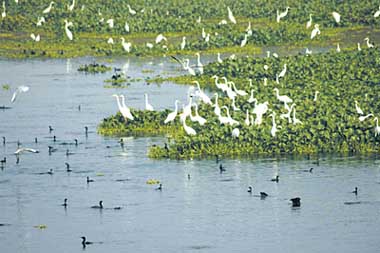
Harike Pattan bird sanctuary at Taran Taran Punjab offers a joy of lifetime
Harike Pattan presents an inspirational example of nature conservation by authorities and non-government organisations. A visit to Harike Pattan bird sanctuary showcases how the golden wealth of nature exists here in its divine glory, untainted and undisturbed. And, why there is need for it to remain like that.
A few non-government agencies have now come forward for the conservation of some precious ecologically important habitats and spread public awareness among locals here.
During autumn, spring and winter, Harike Pattan turns a shelter for hundreds of species of birds. It is strategically situated for birds migrating to and from central Asia and Siberia.
It is one of the ancient confluences where the rivers Satluj and Beas converge. It's a quite sacred place. The confluence has been developed among the world's top 10 centauries. It is one of the largest wetlands of India and for centuries it has been home to migratory birds. The people of Punjab are familiar with these birds, as they are the best friends of children.
The sanctuary came into existence with the construction of a barrage at the confluence of the river Beas and Satluj for water storage and providing irrigation and drinking water. In 1978, the Punjab government declared the water-based body a wildlife sanctuary.
Friday, September 12, 2008
Hazur Sahib, Nanded readies to receive Sikh multitudes for Gurta Gaddi Diwas
Saturday, September 06, 2008
Enabling devotees at Dera Baba Nanak to catch a glimpse of Kartarpur Sahib gurdwara in Pakistan
Over the years, the demand to have a corridor to the shrine has gathered momentum. Even Prime Minister Manmohan Singh reiterated his desire to have a corridor to the holy place so that devotees can visit it without any restrictions.
Talking to The Tribune, Baba Sukhdeep Singh Bedi, who claims to be a descendant of Guru Nanak Dev, said he had shouldered the responsibility so that sangat could offer prayers easily. Earlier, the devotees had to sit at the Dhussi Bandh and there were no facilities of any kind at that place. The conditions used to worsen in case of inclement weather, he pointed out.
He said the viewing area comprises a spacious cabin for visiting dignitaries and a roofed stand for general public. In addition to it, binoculars would be provided to the visitors so that they can have a closer look. Funding had never been a problem since devotees have offered their help regularly. All the material had been procured keeping the aesthetic beauty of place in mind, Bedi added. The BSF officials said they tried their best to help the devotees and had improved the road network in the area with the help of Border Area Development Funds. An official said when the BSF told the Pakistani Rangers that some trees block the view of the historic gurdwara from India’s side, the later pruned those trees to give a better vision.
Tuesday, September 02, 2008
World's first Sikh University to come up at Fatehgarh Sahib in Punjab
Punjab Chief Minister Parkash Singh Badal will Monday lay the first stone of the foundation monument - the 'Minar-e-Ikonkar' (Tower of God is one) - in this historic Sikh holy town, around 60 km from Chandigarh.
The university, spread over 84 acres given by the Shiromani Gurudwara Prabandhak Committee (SGPC), is coming up in an year which also marks the 300th anniversary of the 'Gurgaddi' (installation) of the Sikh holy book, Guru Granth Sahib, at 'Harmandar Sahib', the holiest of Sikh shrines, in Amritsar. Though founded with traditional values espoused by the Sikh religion, the university will deal with contemporary issues like the authentic interpretation of Sikhism in the modern context and idiom, role of Sikhism in the making of the 21st century society and the third millennium civilization, a state government spokesman said.
It also aims at addressing contemporary problems of Sikh identity vis-a-vis forces and processes of globalisation, facts about the Sikh diaspora and role of Sikhism and global interfaith dialogue, he added.
Sikhism is one of the youngest religions in the world, founded by the first Sikh guru, Nanak Dev, in the 15th century. The Sikhs, considered one of the most progressive communities, traditionally hail from the north Indian state of Punjab.
Besides the routine courses in arts, science and other fields, the university will focus on emerging technologies such as bio-technology, nano-technology, information technology and disciplines like ecology, human rights, feminism, empowerment of the down-trodden and other related spheres.
To give the university a 21st century outlook, it is looking at multi-national companies and other international universities for tie-ups. The spokesman said that arrangements will be made with foreign universities to enable scholars of Sri Guru Granth Sahib World University to be sent abroad as part of the course study.
Regional and overseas extension centres of the University will be established in India, North America, Europe, Southeast Asia and other countries wherever Sikhs and Sikhism have reached.
The university authorities are also planning to rope in the Sikh diaspora in the new venture.
The university also gives the students an option to undertake advanced studies in Sikhism - its philosophy, ethics, relation with other religions, history, music, linguistics, holy shrines and historical places associated with the religion, architecture, paintings, way of life, martial arts, diaspora and role of Sikhism in the 21st century.
Sunday, August 31, 2008
Film Sat Sri Akal – a story of love and faith
Not very long ago, we wanted “good Sikh characters” in Bollywood and Hollywood. If a young Ishmeet Singh or Manpreet Singh chooses to have acting as a career and their visibility happens to be more, much to the chagrin of those who don’t like Sikhs in cinema, it is certainly not their fault. Neither Manmeet Singh nor Manpreet Singh goes around town exhorting young Sikhs to join films. Some of these young people are doing yeoman’s service besides their careers and that needs to be appreciated.
With the fully bearded and turbaned Manpreet Singh as the lead hero, Sat Sri Akal will foster renewed interest in the Sikh face. Whatever happens, Bollywood will have to sit up, listen and take notice. In the years to come, it will become more difficult for them to malign Sikhs as they have doing for all these years.
In this historic year of the Sikh calendar, Sat Sri Akal will be a much talked about movie, because it puts on celluloid the true strains of Sikhism, the ethos of faith in Guru Granth Sahib and the importance of tradition and values in modern day life. The protagonists, the Mata Tripta Ji Charitable Trust, Chandigarh have been working hard to ensure that the movie reflects the spirit of Sikhism. Shot on location at Darbar Sahib and Hazur Sahib, the producers say that the film “literally symbolizes and implies truth, divinity and cheer in true harmony.” Interestingly, it is based on a true story and though it has Sikh characters and a Punjabi background, it has a universal appeal.
The cast and crew is essentially Punjabi and the writer Arvinderjit Singh has spared no effort to encapsulate Punjabi culture, moral values and Sikh tenets. The music of the movie also has the Punjabi touch with a string of percussion instruments and singers like Jagjit Singh. Among the Shabads in the movie, there is Dithe Sabhe Thaav, sung by late Ishmeet Singh, much before he became the Voice of India.
With the marketing support of Frankfinn Entertainment co, the film is likely to go worldwide and with the Diaspora interest in Sikh characters gradually increasing, the film is set to attract much-deserved attention.
Thursday, August 28, 2008
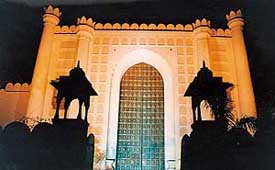
Hotel Ramgarh Fort near Chandigarh has tallest Door in country
The “Buland Darwaza” at Fatehpur Sikri stands 120 ft tall, including the steps and the constructed area but the actual door is only 23 ft. The door at the Bathinda fort in Punjab is 26 feet high.
Interestingly, the doors of forts and palaces were kept exceptionally tall in previous centuries so that the rajas sitting on elephants could enter without dismounting. Hence they were often called hathi deorhi.
The door of the fort is a replica of the original door, which was built 300 years back by the Chandel Rajput dynasty but broken during the 1857 mutiny. The replica was reconstructed in late 1980, by Kanwar Mohan Singh, a scion of the former ruling family of Ramgarh, is now a part of the premises converted into a heritage hotel. Each of its two panels weighs 21 quintals despite which, it can be easily closed and opened. About 2000 man-days were spent in putting the new door together with 343 custom-made copper plates and 343 spikes on it.
Spikes were used on the doors in olden days so that these could not be broken by an attacking army with the help of elephants banging their heads on it.
Tuesday, August 26, 2008
Negotiations to Purchase Historic Gurdwara Baoli Sahib at Jagannath Puri in Orissa
Like many other Sikh historic places, Gurdwara Baoli Sahib is desperately in need of conservation.
A painting of Guru Nanak languishing in the gurdwara shows the Guru sitting under a tree with his two sons sitting to his right, and his companion, Mardana, playing the rabaab, also to his right. When I saw it in February, it was in very sad condition.
The decrepit baoli, a stepped well that goes down to the water surface, marks the spot in the sand where Guru Nanak dug his staff to release a spring of sweet water, the only source of drinkable water in the area.
The gurdwara is very small. There are two rooms, one for Guru Granth Sahib and the other for Lord Jagannath. The caretaker priest does both Sikh and Hindu prayers.
About a mile from Gurdwara Baoli Sahib stands a newer gurdwara, Nanakmata Sahib, which was built less than 10 years ago. It has 24-hour open langar and a building next door for travelers to stay.
There is also a lot across the road, just in front of the gurdwara, large enough to build three homes. It was donated to the gurdwara by the city of Puri. Gurdwara officials said they were planning to build a children’s park and a library named after one of the Panj Piaray, Mohkam Singh, who was from Puri.
Puri does not have any Sikh resident, but the sangat regularly goes to Gurdwara Nanakmata Sahib from the neighboring state capital of Bhubaneshwar and from the city of Cuttack.
Gurdwara Nanakmata Sahib is working with the Shiromani Gurdwara Parbandhak Committee to take possession of the old historical Gurdwara Baoli Sahib. Its secretary said the government and the Brahmin family at Baoli Sahib had agreed, in principle, to hand it over, at an agreed price.
When that will happen is not known, but hope the Baoli Sahib family is given millions of rupees for their seva and for passing the responsibility of the gurdwara on to the Sikhs.
Jagannath Puri, on the shores of the Bay of Bengal, is one of the four most sacred places of pilgrimage for Hindus. A special ritual, called aarti, is performed in praise of Lord Jagannath, Lord of the universe. Aarti worship involves circulating a metal platter on which little lamps with butter-soaked wicks are lit.
Guru Nanak watched pilgrims doing aarti at Jagannath Puri during his odyssey in the mid 1500s. He did not participate. Instead, he sang a shabad about the true realm of Waheguru, in which aarti is meaningless.
Sunday, August 24, 2008
Punjabi Jutti no more a popular wear
Punjabi Jutti was known for its immaculate embroidery and varied hues which made it a popular wear for the people of the region for all types of occasions.But today it appears to be on its way out in absence of any government support and in face of fashion trends which are too fast-paced for the practitioners of this trade to keep abreast of, almost bringing down curtain on this century-old tradition.
A survey revealed that this handicraft business are fast shrinking. The Punjabi Jutti market near the Quila Mubarak in Patiala, which once enjoyed an enviable reputation for this trade, is finding the old hands there no more keen on this craft. Thousands of families involved in making these Jutti since 19th century are unable to earn enough to keep their body and soul together and are feeling compelled to bid adieu to their trade.
“The Jutti was in a great demand in early 60s and 70s, but 90 onwards, there was a decline in its popularity. Due to new trends in fashion, it was no more a daily wear. Although we tried our level best to keep pace with these trends, but due to lack of enough funds at our disposal and frequent changes in fashion, we failed to cater to the need,” revealed some of the families involved in the trade said.
Apart from this, the new taxes on the raw material like leather has further tightened the noose around this business. Earlier, there was no tax on leather, but now it has been brought under the ambit of Vat, thus leaving the makers of these Jutti with no option but to bow out. Earlier, this business was allowed some subsidies too. But now with subsidy gone and on the top of it extra levies slapped, the margins have come down drastically.Revealed the owner of Punjabi Jutti House, Jagdish Kumar, “Earlier, one shopkeeper used to have a nearly Rs 3-5 lakh turnover every year, but now it has come down by 70 pc and our commerce with various distributors from Delhi, Gurgaon and Bombay has also declined.”
‘Each one, Teach one’ - It’s learn & teach in Punjab college
"The first time in front of a class is daunting but now I lecture confidently," says 18-year-old Harpreet Kaur, a econdyear BA student who teaches first-year students. All disputes are also resolved by the students themselves to boost their problemsolving skills.
Not just teaching, everything here is inhouse. Students cook, wash clothes and clean the campus, eliminating the need for any staff. Enter the building, and it is difficult to distinguish teacher from the taught, cook from sweeper. Clad in white salwar-kameez with heads covered in white dupattas, students rotate duties as teacher, cook and sweeper. The principal’s wife, Jagdish Kaur, oversees all kitchen activities.
"In our institution, the annual expenditure for a day scholar is Rs 800 and Rs 6,000 for a boarder," says octogenarian Swaran Singh Virk, who besides being principal is administrator, guide and mentor for students. Presently, the hostel accommodates about 2,000 students.
The college also has its own flour mill, saw mill and cane-sugar grinder, dairy farm and even a biogas plant that supplies gas to the kitchen, thereby saving at least Rs 1,000 a day. Use of solar power also helps cut their energy bill by a further Rs 10,000 per year.
The extra income goes towards educating kids who can’t afford to pay even the Rs 800 annual fee, says Virk. Though it has no affiliation, Guru Nanak Dev University has established an exam centre here and evaluates answersheets.
And though self-sufficiency is the guiding principle behind this college, the results are proof that academics aren’t neglected. The pass percentage every year is 99-100%, with almost 80% getting first division.
Sikh Tourism introduces Punjab Village Tour
Sikh Tourism has introduced a new travel package "Punjab Village Tour" which will take you to Sikh Cultural, Religious, Rural & Heritage life of Punjab Cities of Patiala, Amritsar, Anandpur and Chandigarh along with darshan of Golden Temple, Anandpur Sahib and Gurudwaras of Delhi.
People have visited the cities of Chandigarh, Jalandhar, Ludhiana, Patiala and Amritsar but may not have seen the actual life of a lively Punjab. For a traveler, Punjab is a wonderful tourist destination and especially if your visit a countryside place or Pind (village)is what you wish to explore on your Punjab Village Tour, spend some in a traditional Punjab village.
During this tour, a traveller will be shown the actual daily life of a villager, given homemade food, could participate in the local works like carpentary, ploughing, cow milking, clay pottery, etc. They could also see the work being done on handicrafts like Phulkari, utensil making, wood work, etc.
For more details, see at http://www.sikhtourism.com/punjab-village-tour.htm