Hemkund Sahib Yatra is again starting in June 2009 and Sikhtourism has made special Delhi Hemkund Sahib Tour Packages for Pilgrimages.
Sri Hemkund Sahib Tours are available only in the summer, between June and October.
Details of the Tour are :
DELHI - HEMKUND SAHIB - DELHI (6 Nights - 7 Days)
Day 1. Delhi - Rishikesh (Drive 240 km)
Day 2. Rishikesh - Joshimath (Drive 257 km)
Day 3. Joshimath - Govind Ghat - Govind Dham(ghangharia) (Drive 21km, Trek 13km )
Day 4. Govind Dham - Hemkund Sahib - Govind Dham (Ghangharia Trek (12 km)
Day 5. Govind Dham - Govind Ghat - Joshimath (Trek 13 km, Drive 21 km)
Day 6. Joshimath - Rishikesh (Drive 257 km)
Day 7. Rishikesh - Delhi (Drive 240 km)
For more details and Prices, visit at Hemkund Sahib Yara
Showing posts with label sikh. Show all posts
Showing posts with label sikh. Show all posts
Sunday, March 29, 2009


Friday, March 20, 2009
Sikhs make Guinness size statement with Blood
More than three hundred years after the tenth Sikh Master, Guru Gobind Singh ji, founded the Khalsa amid the hilly terrains of Sri Anandpur Sahib, this holy town once again gift wrapped another great gift to the humanity from the Sikh community -- the world's largest ever blood donation camp.
As long serpentine queues of hundreds of donors on Hola Mohalla, March 11 2009, continued till late Tuesday night, each over enthusiastic to stress Sikhism's message of universal brotherhood and welfare of all (Sarbat Da Bhala), blood unit count crossed the figure of 20,000 and could well have touched 25,000, shattering the earlier Guinness Book record of 13,000 plus units collected in a single day.
Backed by Sri Akal Takht Sahib and other Sikh temporal seats, and enjoying patronage of more than a hundred Sikh organisations, the blood donation drive broke all barriers of age, gender, caste and economic status as young and old, poor and rich, men and women awaited patiently their turn to make a statement with blood at a time when much of it is being shed across the world in the name of religion.
At a time when rest of India was busy playing Holi with colors or cow dung, the Sikh community was making a statement with this drive. 25,000 units of blood in flat 24 hours was the target, and the organizers, led from the front by Akal Purakh Ki Fauj outfit, had made sure that all mandatory requirements of the administrators of Guinness Records are fulfilled and cameras keep a record of all donors, quality checks are stringent, medical care at its best and safe blood keeping practices are followed.
The sheer scale of logistics was mind boggling as the camp spilled over on to two lakh square feet of makeshift tents, 700 beds divided in 14 blocks of 50 beds each, and averaging 2,500 donations in one hour. All this effort was possible, thanks to an army of 8,000 volunteers, 3000 paramedical staff and 100 doctors deployed for the camp. Army personnel from Jalandhar and Chandi Mandir were among the teams collecting units.
The Holla Mohalla festival attracts lakhs of pilgrims from all over Punjab and the rest of the country and is the festival of truth, courage, bravery and service. The milling crowds of Sikhs who came to know of the camp added largely to the success of the effort, monitored for Guinness record purposes.
Sikh enthusiasts had come from, thanks to the massive mobilization campaign to ply blood donors, as far as Maharashtra, UP, Uttarkhand, Jammu and Kashmir and Haryana.
Thursday, March 19, 2009
London gurdwara gutted in racist attack
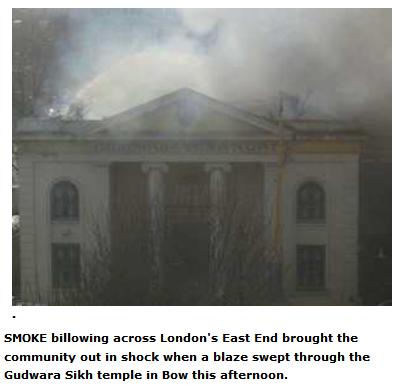
One of London's most important gurdwara, housing priceless religious books, has been gutted in a suspected racist attack in Britain, a news report said on Tuesday. Eye-witnesses on Tuesday said that a man, who entered the Gurdwara Sikh Sangat in East London, managed to escape just before flames were first seen. A group of women, who had spotted the intruder, tried to put out the raging flames in one of the holiest parts of the gurdwara, which was built at Bow in 1979.
Most of the gurdwara's roof collapsed and worshipers fear all but one of its eight holy books have been destroyed, the ‘Evening Standard’ newspaper said on Tuesday. Eye-witnesses described the suspected arsonist as being black or mixed-race. A worshiper said he had noticed racist graffiti on one of the gurdwara's outer walls in the past few weeks.
A criminal investigation has been launched and police and fire investigators are treating the blaze as suspicious. The building, which dates back to 1854 was formerly a synagogue and before that a chapel. The London Fire Brigade confirmed that 75 per cent of the building and the roof had been damaged by the fire.
"Police are treating this incident as suspicious," a Metropolitan police spokesman was quoted as saying by the British daily.
More than 50 firefighters battled the flame for almost eight hours after being called just after 2 p.m. yesterday, the report said.
Wednesday, March 11, 2009
Hola Mahalla at Anandpur Sahib
Hola Mohalla or Hola Mahalla or simply Hola is a Sikh festival that takes place on the first of the lunar month of Chet which usually falls in March. This, by a tradition estabished by Guru Gobind Singh, follows the Hindu festival of Holi by one day; Hola is the masculine form of the feminine sounding Holi. The word "Mohalla" is a Punjabi word that implies an organized procession in the form of an army column. But unlike Holi, when people playfully sprinkle color, dry or mixed in water, on each other, the Guru made Hola Mohalla an occasion for the Sikhs to demonstrate their martial skills in simulated battles.
Together the words "Hola Mohalla" stands for "mock fight". During this festival, processions are organised in the form of army type columns accompanied by war-drums and standard-bearers and proceeding to a given spot or moving in state from one gurdwara to another. The custom originated in the time of Guru Gobind Singh who held the first such mock fight event at Anandpur in February 1701.
The foothills of the Shivaliks in Ropar district of Punjab's north-eastern region, especially around the historic townships of Anandpur Sahib and Kiratpur Sahib, have, since 1701 been playing host to Hola Mohalla. Recently, the Indian government accorded it the status of a national festival. The military exercise, which was personally supervised by the guru, was carried out on the bed of the River Charan Ganga with the famous Hindu temple of Mata Naina Devi in the Shivaliks as the backdrop.
This annual festival held at Anandpur Sahib in Punjab and now replicated at other Gurdwaras worldwide was started by the tenth Sikh Guru, as a gathering of Sikhs for military exercises and mock battles on the day following the festival of Holi at Anandpur Sahib. It reminds the people of valour and defence preparedness, concepts dear to the Tenth Guru who was at that time battling the Mughal empire and the hill kings. On this three-day grand festival, mock battles, exhibitions, display of weapons, etc., are held followed by kirtan, music and poetry competitions. The participants perform daring feats, such as Gatka (mock encounters with real weapons), tent pegging, bareback horse-riding, standing erect on two speeding horses and various other feats of bravery.
There are also a number of Darbars where the Sri Guru Granth Sahib is present and kirtan and religious lectures take place. On the last day a long procession, led by Panj Pyaras, starts from Takhat Keshgarh Sahib, one of the five Sikh religious seats, and passes through various important Gurdwaras like Qila Anandgarh, Lohgarh Sahib, Mata Jitoji and terminates at the Takhat (Keshgarh).
For people visiting Anandpur Sahib, langars (voluntary community kitchens) are organized by the local people as a part of sewa (community service). Raw materials like wheat flour, rice, vegetables, milk and sugar are provided by the villagers living nearby. Women volunteer to cook and others take part in cleaning utensils and other manual tasks that need to be carried out. Traditional cuisine is served to the pilgrims who eat while sitting in rows on the ground. (Pangat)
The popularity of this festival may be judged from the fact that out of five Sikh public holidays requested by the Khalsa Diwan, Lahore in 1889, the Government approved only two - Holla Mahalla and the birth anniversary of Guru Nanak. Hola Mahalla is presently the biggest festival at Anandpur.
Monday, October 13, 2008
Gurudwara Saragarhi memorial, a tribute to the gallantry of 21 Sikh soldiers
Every year Sikhs in Punjab's Ferozepur district mark Saragarhi Day to remember the unparalleled valour, demonstrated by 21 Sikh soldiers on September 12, 1897 while participating in the battle of Saragarhi against a 10,000 strong enemy force.The Sikh soldiers of the 4th Battalion (then 36th Sikhs) of the Sikh Regiment of British India were sent to defend Fort Lockhart at Saragarhi post, in North West Frontier Province (now in Pakistan). Some 10,000 tribesmen had attacked the Saragarhi post. The battle lasted over six hours and one by one the defenders kept falling while trying to protect their post. But they did not surrender. The day of battle is observed each year as `Saragarhi Day' to mark the event.
The Gurudwara, named Saragarhi memorial, in Ferozepur today stands as a protected monument and is a tribute to those Sikh soldiers who sacrificed their lives. The memorial gurudwara, surrounded by half-a-dozen small and big cannons with names of the 21 brave soldiers inscribed on its walls, was built by the army with stones from the Saragarhi post. It was declared open in 1904 by Sir Charles Revz. Saragarhi memorial is an inspiration to many a symbol of courage and bravery.
Captain Sadhu Singh of the Sikh Regiment, said:" About 110-years-ago, on 12th of September, 1897 a war was fought, in which 21 brave soldiers were martyred while fighting under the leadership of Hawaldar Ishwar Singh at Saragarhi Post. In memory of those martyrs, we celebrate this day every year. Whatever our ancestors have given us in legacy is for the making of our nation and community proud. "
On the occasion of 110th anniversary of the Saragarhi Day a cross-country run was held in which hundreds of civilians as well as army personnel participated. After covering a distance of nine miles on the Faridkot-Ferozepur Road, the run culminated at the Saragarhi Memorial Gurudwara. The Sikh Regiment organized cross-country and cycle rally with the support of the state government to inspire youth and instill a spirit of sacrifice for the motherland in them.
Ferozepur city in South-west Punjab is on the sensitive border with Pakistan that has witnessed three wars. The border village lacks medical facilities and to make the Saragarhi Day a memorable one the army also organized a free medical camp .
Each year by observing the Saragarhi Day, the spirit and inspiration is kept alive from generation to generation.
Tuesday, September 02, 2008
World's first Sikh University to come up at Fatehgarh Sahib in Punjab
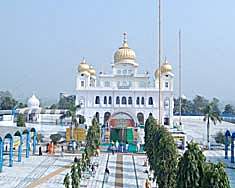 Fatehgarh Sahib, Punjab, is a holy town for Sikhs, where two sons of the 10th Sikh Guru, Gobind Singh, attained martyrdom in the 18th century, is set to be home to the first Sikh university - the Sri Guru Granth Sahib World University.
Punjab Chief Minister Parkash Singh Badal will Monday lay the first stone of the foundation monument - the 'Minar-e-Ikonkar' (Tower of God is one) - in this historic Sikh holy town, around 60 km from Chandigarh.
The university, spread over 84 acres given by the Shiromani Gurudwara Prabandhak Committee (SGPC), is coming up in an year which also marks the 300th anniversary of the 'Gurgaddi' (installation) of the Sikh holy book, Guru Granth Sahib, at 'Harmandar Sahib', the holiest of Sikh shrines, in Amritsar. Though founded with traditional values espoused by the Sikh religion, the university will deal with contemporary issues like the authentic interpretation of Sikhism in the modern context and idiom, role of Sikhism in the making of the 21st century society and the third millennium civilization, a state government spokesman said.
It also aims at addressing contemporary problems of Sikh identity vis-a-vis forces and processes of globalisation, facts about the Sikh diaspora and role of Sikhism and global interfaith dialogue, he added.
Sikhism is one of the youngest religions in the world, founded by the first Sikh guru, Nanak Dev, in the 15th century. The Sikhs, considered one of the most progressive communities, traditionally hail from the north Indian state of Punjab.
Besides the routine courses in arts, science and other fields, the university will focus on emerging technologies such as bio-technology, nano-technology, information technology and disciplines like ecology, human rights, feminism, empowerment of the down-trodden and other related spheres.
To give the university a 21st century outlook, it is looking at multi-national companies and other international universities for tie-ups. The spokesman said that arrangements will be made with foreign universities to enable scholars of Sri Guru Granth Sahib World University to be sent abroad as part of the course study.
Regional and overseas extension centres of the University will be established in India, North America, Europe, Southeast Asia and other countries wherever Sikhs and Sikhism have reached.
The university authorities are also planning to rope in the Sikh diaspora in the new venture.
The university also gives the students an option to undertake advanced studies in Sikhism - its philosophy, ethics, relation with other religions, history, music, linguistics, holy shrines and historical places associated with the religion, architecture, paintings, way of life, martial arts, diaspora and role of Sikhism in the 21st century.
Sunday, August 31, 2008
Film Sat Sri Akal – a story of love and faith

Slated for release in the last week of September, Sat Sri Akal –a story of love and faith, is a cinematic contribution for the Tricentenary Gurta Gaddi celebrations.
Are cinema characters to serve as role models? Is eulogizing a Sikh achiever in the field of music and cinema tantamount to preparing Sikhs for a stint in Bollywood? Well, the times are changing and changing fast. Sometime back, we were yearning for a radio station at Darbar Sahib, now we are looking at setting up a regulatory authority to monitor the plethora of channels blaring religious untruths and falsehood.
Not very long ago, we wanted “good Sikh characters” in Bollywood and Hollywood. If a young Ishmeet Singh or Manpreet Singh chooses to have acting as a career and their visibility happens to be more, much to the chagrin of those who don’t like Sikhs in cinema, it is certainly not their fault. Neither Manmeet Singh nor Manpreet Singh goes around town exhorting young Sikhs to join films. Some of these young people are doing yeoman’s service besides their careers and that needs to be appreciated.
With the fully bearded and turbaned Manpreet Singh as the lead hero, Sat Sri Akal will foster renewed interest in the Sikh face. Whatever happens, Bollywood will have to sit up, listen and take notice. In the years to come, it will become more difficult for them to malign Sikhs as they have doing for all these years.
In this historic year of the Sikh calendar, Sat Sri Akal will be a much talked about movie, because it puts on celluloid the true strains of Sikhism, the ethos of faith in Guru Granth Sahib and the importance of tradition and values in modern day life. The protagonists, the Mata Tripta Ji Charitable Trust, Chandigarh have been working hard to ensure that the movie reflects the spirit of Sikhism. Shot on location at Darbar Sahib and Hazur Sahib, the producers say that the film “literally symbolizes and implies truth, divinity and cheer in true harmony.” Interestingly, it is based on a true story and though it has Sikh characters and a Punjabi background, it has a universal appeal.
The cast and crew is essentially Punjabi and the writer Arvinderjit Singh has spared no effort to encapsulate Punjabi culture, moral values and Sikh tenets. The music of the movie also has the Punjabi touch with a string of percussion instruments and singers like Jagjit Singh. Among the Shabads in the movie, there is Dithe Sabhe Thaav, sung by late Ishmeet Singh, much before he became the Voice of India.
With the marketing support of Frankfinn Entertainment co, the film is likely to go worldwide and with the Diaspora interest in Sikh characters gradually increasing, the film is set to attract much-deserved attention.
Sikh News by Sikh Tourism
Subscribe to:
Posts (Atom)