Showing posts with label punjab social life. Show all posts

Saturday, October 15, 2011

Punjab Cuisine and Cooking Tour


Punjabi Cooking Tour

Punjabi Cooking Tour - 1 Night/2 Days :
Day 1Pickup from Amritsar Railway station and transfer to hotel, Later visit Golden Temple Amritsar, Dinner & night at hotel
Day 2. Breakfast, Attend Punjabi Cooking class and learn how to cook Punjabi Dishes. Lunch and Tea at the class only. Evening drop at Railway station Amritsar.


Option : Tour can be arranged from Delhi also (Delhi-Amritsar Train Tour) :


Amritsar Food Tour  : 2 Nights/3 Days :
Day 1. Pickup from Amritsar Railway station and transfer to hotel, Later visit Golden Temple Amritsar, Dinner & night at hotel
Day 2. Breakfast, Attend Punjabi Cooking class and learn how to cook Punjabi Dishes. Lunch and Tea at the class only, Dinner &  night at hotel. 
Day 3
. Breakfast, Full day tour of a Punjab Village experiencing the real & actual life of a traditional Punjab village and Punjabi Food. Evening drop at Railway station Amritsar.


For more details, visit us at :


Wednesday, October 06, 2010

Punjab Farm House/ Village Tours

Punjab Farmhouse Tour

Punjab Farmhouse combines the comforts of staying in a modern furnished accommodation with the hospitality of a Punjabi family within the traditions, culture and environment. You can stay in the Punjabi Farmhouse and experience the real Punjabi life, food, customs and rituals.

You can also experience the Farmhouse or traditional rural life of Punjab along with its agricultural and rural aspects.

For more details, click http://www.sikhtourism.com/punjab-farmhouse-tour.htm

Friday, March 20, 2009

Sikhs make Guinness size statement with Blood

More than three hundred years after the tenth Sikh Master, Guru Gobind Singh ji, founded the Khalsa amid the hilly terrains of Sri Anandpur Sahib, this holy town once again gift wrapped another great gift to the humanity from the Sikh community -- the world's largest ever blood donation camp.

As long serpentine queues of hundreds of donors on Hola Mohalla, March 11 2009, continued till late Tuesday night, each over enthusiastic to stress Sikhism's message of universal brotherhood and welfare of all (Sarbat Da Bhala), blood unit count crossed the figure of 20,000 and could well have touched 25,000, shattering the earlier Guinness Book record of 13,000 plus units collected in a single day.

Backed by Sri Akal Takht Sahib and other Sikh temporal seats, and enjoying patronage of more than a hundred Sikh organisations, the blood donation drive broke all barriers of age, gender, caste and economic status as young and old, poor and rich, men and women awaited patiently their turn to make a statement with blood at a time when much of it is being shed across the world in the name of religion.

At a time when rest of India was busy playing Holi with colors or cow dung, the Sikh community was making a statement with this drive. 25,000 units of blood in flat 24 hours was the target, and the organizers, led from the front by Akal Purakh Ki Fauj outfit, had made sure that all mandatory requirements of the administrators of Guinness Records are fulfilled and cameras keep a record of all donors, quality checks are stringent, medical care at its best and safe blood keeping practices are followed.

The sheer scale of logistics was mind boggling as the camp spilled over on to two lakh square feet of makeshift tents, 700 beds divided in 14 blocks of 50 beds each, and averaging 2,500 donations in one hour. All this effort was possible, thanks to an army of 8,000 volunteers, 3000 paramedical staff and 100 doctors deployed for the camp. Army personnel from Jalandhar and Chandi Mandir were among the teams collecting units.

The Holla Mohalla festival attracts lakhs of pilgrims from all over Punjab and the rest of the country and is the festival of truth, courage, bravery and service. The milling crowds of Sikhs who came to know of the camp added largely to the success of the effort, monitored for Guinness record purposes.

Sikh enthusiasts had come from, thanks to the massive mobilization campaign to ply blood donors, as far as Maharashtra, UP, Uttarkhand, Jammu and Kashmir and Haryana.

Sunday, March 01, 2009

Devotees offer toy plane at Gurudwara Talhan to go abroad

A large number of devotees, seeking greener pastures abroad, head towards a Gurudwara devoted to Sant Baba Nihal Singh Shaheedan in Village Talhan of Punjab's Doaba region. Thousands of individuals in Doaba region hold this holy shrine in high-esteem. And, these devotees include many of those who have long been nurturing a dream to get a visa to go abroad but couldn't get it. The popular feeling about this Gurudwara is that anyone offering a toy plane here can have his or her wish to go abroad fulfilled. Hence a lot of people visit this holy shrine and make a wish to go abroad. For this, the devotees make an offering of toy planes; inscribed with names of different carriers. Devotees buy these toy planes from the shops outside this Gurudwara and they offer it to Sri Guru Granth Sahib.

It all started a few months back, when the word spread that wishes of settling abroad would be fulfilled if one offered a toy plane at the shrine. On Sundays, about 40-50 planes are offered. In most cases, devotees who wish to fly to a particular country offer a toy plane of the airline of that country.

In Doaba region, where going abroad is dream of most people, a large number of people have an unshakable faith in the Gurudwara.

It has become a difficult task for the Gurudwara authorities to store so many toy planes. Punjabi youth, who dream of greener pastures abroad, come in large numbers after they hear stories of wishes of their friends to settle abroad being fulfilled after they offered planes at the Talhan Gurudwara.

"Whenever somebody's wish of going abroad is fulfilled, they come here at the Gurudwara to offer a plane. Punjabis from all parts of the world - England, America, Canada and many other countries come here," said one young devotee.

For the Punjabi youth, spending three to 10 dollars in buying a toy airplane hardly matters, if it increases the possibility of ultimately realizing a million-dollar dream.

Monday, October 06, 2008

Sikh guru in Heroes of Environment list

Heaping praises on environmentalist Baba Balbir Singh Seechewal for launching a campaign to clean up the polluted 'Kali Bein' in Punjab, Time magazine has profiled the Sikh sect leader as one of the 30 'Heroes of Environment' selected from across the globe. Describing Seechewal as the man 'who set out to clean up this mess', the magazine lauded him for mobilising people to launch a movement that taught the people why they should clean the 'Kali Bein'.

'We have proved that it is possible to restore our rivers to a pristine condition if we all come together,' Seechewal told the Time magazine.

'It is time to do that on a bigger scale,' he said.

'Kali Bein', the 160-km-long river in Hoshiarpur district in Punjab, was reduced to a filthy drain into which people from more than six towns and 40 villages emptied their waste, leaving neighbouring farmlands parched. The river was revived a couple of years back after Seechewal and his followers took up the cause and raised funds to clean the river, which is now a favourite picnic spot.

Sikhs believe that Guru Nanak Dev attained enlightenment after taking a dip in 'Kali Bein' 500 years back before founding Sikhism.

'In 2000, Seechawal, a Sikh holy man, set out to clean up the mess in the river. The scale of the task was gigantic-volunteers cleared the entire riverbed of water hyacinth and silt, and built riverbanks and roads alongside the river,' the magazine wrote.

Seechawal launched a public-awareness campaign asking the villagers to dispose of their sewage elsewhere and some people revived traditional methods of waste disposal and treatment.

'A government order to divert water from a nearby canal was eventually obtained. As the riverbed was cleared, natural springs revived and the river began to fill up. Since then trees have been planted along its banks and fishing has been preserve biodiversity,' the magazine said.

Tuesday, September 16, 2008

Harike Pattan bird sanctuary at Taran Taran Punjab offers a joy of lifetime

Harike wetland in Punjab’s Taran Taran District is the second largest bird sanctuary of India. It’s home to rare varieties of avifauna arriving here from different parts of Europe and northern Asia for stay during a major part of the year. About 60 kilometres from Amritsar, it is one of the largest freshwater wetlands in north India and is spread over 93 square miles. Of the total expanse of the wetland area of Harike Pattan, 26 square miles is open water.

Harike Pattan presents an inspirational example of nature conservation by authorities and non-government organisations. A visit to Harike Pattan bird sanctuary showcases how the golden wealth of nature exists here in its divine glory, untainted and undisturbed. And, why there is need for it to remain like that.

A few non-government agencies have now come forward for the conservation of some precious ecologically important habitats and spread public awareness among locals here.

During autumn, spring and winter, Harike Pattan turns a shelter for hundreds of species of birds. It is strategically situated for birds migrating to and from central Asia and Siberia.

It is one of the ancient confluences where the rivers Satluj and Beas converge. It's a quite sacred place. The confluence has been developed among the world's top 10 centauries. It is one of the largest wetlands of India and for centuries it has been home to migratory birds. The people of Punjab are familiar with these birds, as they are the best friends of children.

The sanctuary came into existence with the construction of a barrage at the confluence of the river Beas and Satluj for water storage and providing irrigation and drinking water. In 1978, the Punjab government declared the water-based body a wildlife sanctuary.

Punjab Tourism News by Sikh Tourism

Thursday, August 28, 2008

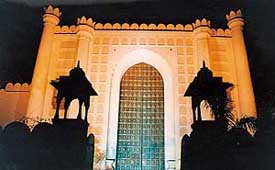
Hotel Ramgarh Fort near Chandigarh has tallest Door in country


It is official. The door of the Fort at Ramgarh is the tallest door in the country higher than even the gate of Fatehpur Sikri near Agra. The latest edition of the Limca Book of Records which is the Indian equivalent to the Guinness Book of Records, lists the entry of the “tallest door” at page number 204.

The wooden door guarding the 350-year-old Ramgarh Fort near Chandigarh measures 37ft in height and 14½ ft in width.

The “Buland Darwaza” at Fatehpur Sikri stands 120 ft tall, including the steps and the constructed area but the actual door is only 23 ft. The door at the Bathinda fort in Punjab is 26 feet high.

Interestingly, the doors of forts and palaces were kept exceptionally tall in previous centuries so that the rajas sitting on elephants could enter without dismounting. Hence they were often called hathi deorhi.

The door of the fort is a replica of the original door, which was built 300 years back by the Chandel Rajput dynasty but broken during the 1857 mutiny. The replica was reconstructed in late 1980, by Kanwar Mohan Singh, a scion of the former ruling family of Ramgarh, is now a part of the premises converted into a heritage hotel. Each of its two panels weighs 21 quintals despite which, it can be easily closed and opened. About 2000 man-days were spent in putting the new door together with 343 custom-made copper plates and 343 spikes on it.

Spikes were used on the doors in olden days so that these could not be broken by an attacking army with the help of elephants banging their heads on it.

Sunday, August 24, 2008

Punjabi Jutti no more a popular wear


Punjabi Jutti was known for its immaculate embroidery and varied hues which made it a popular wear for the people of the region for all types of occasions.But today it appears to be on its way out in absence of any government support and in face of fashion trends which are too fast-paced for the practitioners of this trade to keep abreast of, almost bringing down curtain on this century-old tradition.

A survey revealed that this handicraft business are fast shrinking. The Punjabi Jutti market near the Quila Mubarak in Patiala, which once enjoyed an enviable reputation for this trade, is finding the old hands there no more keen on this craft. Thousands of families involved in making these Jutti since 19th century are unable to earn enough to keep their body and soul together and are feeling compelled to bid adieu to their trade.

“The Jutti was in a great demand in early 60s and 70s, but 90 onwards, there was a decline in its popularity. Due to new trends in fashion, it was no more a daily wear. Although we tried our level best to keep pace with these trends, but due to lack of enough funds at our disposal and frequent changes in fashion, we failed to cater to the need,” revealed some of the families involved in the trade said.

Apart from this, the new taxes on the raw material like leather has further tightened the noose around this business. Earlier, there was no tax on leather, but now it has been brought under the ambit of Vat, thus leaving the makers of these Jutti with no option but to bow out. Earlier, this business was allowed some subsidies too. But now with subsidy gone and on the top of it extra levies slapped, the margins have come down drastically.Revealed the owner of Punjabi Jutti House, Jagdish Kumar, “Earlier, one shopkeeper used to have a nearly Rs 3-5 lakh turnover every year, but now it has come down by 70 pc and our commerce with various distributors from Delhi, Gurgaon and Bombay has also declined.”