Punjab Farmhouse Tour
Punjab Farmhouse combines the comforts of staying in a modern furnished accommodation with the hospitality of a Punjabi family within the traditions, culture and environment. You can stay in the Punjabi Farmhouse and experience the real Punjabi life, food, customs and rituals.
You can also experience the Farmhouse or traditional rural life of Punjab along with its agricultural and rural aspects.
For more details, click http://www.sikhtourism.com/punjab-farmhouse-tour.htm
Showing posts with label punjab tours. Show all posts
Showing posts with label punjab tours. Show all posts
Wednesday, October 06, 2010
Monday, March 23, 2009
Chandigarh Rock Garden will sell sculptures
The Chandigarh administration has approved the beautification and development plan for the Rock Garden. Proposed by its founder creator Nek Chand, the structural re designing is meant to improve the aesthetic view of the entire garden. Low height sculptures will also be sold at the Rock Garden for tourists.
UT Home-cum-Tourism Secretary, Mr. Ram Niwas today chaired a meeting regarding the beautification and development of Rock Garden in which various proposals put forward by Sh. Nek Chand for adding more artistic value to the garden were discussed .The Structural Re -designing would be undertaken in order to improve the aesthetic view of the entire garden .Similarly some low height sculptures will be planned apart from establishment within the premises of Rock Garden which would facilitate the tourists to take back memories of Chandigarh.
Friday, March 20, 2009
Sikhs make Guinness size statement with Blood
More than three hundred years after the tenth Sikh Master, Guru Gobind Singh ji, founded the Khalsa amid the hilly terrains of Sri Anandpur Sahib, this holy town once again gift wrapped another great gift to the humanity from the Sikh community -- the world's largest ever blood donation camp.
As long serpentine queues of hundreds of donors on Hola Mohalla, March 11 2009, continued till late Tuesday night, each over enthusiastic to stress Sikhism's message of universal brotherhood and welfare of all (Sarbat Da Bhala), blood unit count crossed the figure of 20,000 and could well have touched 25,000, shattering the earlier Guinness Book record of 13,000 plus units collected in a single day.
Backed by Sri Akal Takht Sahib and other Sikh temporal seats, and enjoying patronage of more than a hundred Sikh organisations, the blood donation drive broke all barriers of age, gender, caste and economic status as young and old, poor and rich, men and women awaited patiently their turn to make a statement with blood at a time when much of it is being shed across the world in the name of religion.
At a time when rest of India was busy playing Holi with colors or cow dung, the Sikh community was making a statement with this drive. 25,000 units of blood in flat 24 hours was the target, and the organizers, led from the front by Akal Purakh Ki Fauj outfit, had made sure that all mandatory requirements of the administrators of Guinness Records are fulfilled and cameras keep a record of all donors, quality checks are stringent, medical care at its best and safe blood keeping practices are followed.
The sheer scale of logistics was mind boggling as the camp spilled over on to two lakh square feet of makeshift tents, 700 beds divided in 14 blocks of 50 beds each, and averaging 2,500 donations in one hour. All this effort was possible, thanks to an army of 8,000 volunteers, 3000 paramedical staff and 100 doctors deployed for the camp. Army personnel from Jalandhar and Chandi Mandir were among the teams collecting units.
The Holla Mohalla festival attracts lakhs of pilgrims from all over Punjab and the rest of the country and is the festival of truth, courage, bravery and service. The milling crowds of Sikhs who came to know of the camp added largely to the success of the effort, monitored for Guinness record purposes.
Sikh enthusiasts had come from, thanks to the massive mobilization campaign to ply blood donors, as far as Maharashtra, UP, Uttarkhand, Jammu and Kashmir and Haryana.
Monday, October 13, 2008
Gurudwara Saragarhi memorial, a tribute to the gallantry of 21 Sikh soldiers
Every year Sikhs in Punjab's Ferozepur district mark Saragarhi Day to remember the unparalleled valour, demonstrated by 21 Sikh soldiers on September 12, 1897 while participating in the battle of Saragarhi against a 10,000 strong enemy force.The Sikh soldiers of the 4th Battalion (then 36th Sikhs) of the Sikh Regiment of British India were sent to defend Fort Lockhart at Saragarhi post, in North West Frontier Province (now in Pakistan). Some 10,000 tribesmen had attacked the Saragarhi post. The battle lasted over six hours and one by one the defenders kept falling while trying to protect their post. But they did not surrender. The day of battle is observed each year as `Saragarhi Day' to mark the event.
The Gurudwara, named Saragarhi memorial, in Ferozepur today stands as a protected monument and is a tribute to those Sikh soldiers who sacrificed their lives. The memorial gurudwara, surrounded by half-a-dozen small and big cannons with names of the 21 brave soldiers inscribed on its walls, was built by the army with stones from the Saragarhi post. It was declared open in 1904 by Sir Charles Revz. Saragarhi memorial is an inspiration to many a symbol of courage and bravery.
Captain Sadhu Singh of the Sikh Regiment, said:" About 110-years-ago, on 12th of September, 1897 a war was fought, in which 21 brave soldiers were martyred while fighting under the leadership of Hawaldar Ishwar Singh at Saragarhi Post. In memory of those martyrs, we celebrate this day every year. Whatever our ancestors have given us in legacy is for the making of our nation and community proud. "
On the occasion of 110th anniversary of the Saragarhi Day a cross-country run was held in which hundreds of civilians as well as army personnel participated. After covering a distance of nine miles on the Faridkot-Ferozepur Road, the run culminated at the Saragarhi Memorial Gurudwara. The Sikh Regiment organized cross-country and cycle rally with the support of the state government to inspire youth and instill a spirit of sacrifice for the motherland in them.
Ferozepur city in South-west Punjab is on the sensitive border with Pakistan that has witnessed three wars. The border village lacks medical facilities and to make the Saragarhi Day a memorable one the army also organized a free medical camp .
Each year by observing the Saragarhi Day, the spirit and inspiration is kept alive from generation to generation.
Wednesday, October 08, 2008
Aman Umeed Tourist Complex at Wagah Border Inaugurated
The Minister of Tourism and Culture has inaugurated a tourist resort, Aman Umeed Bhawan, earlier popularly known as Neem Chameli at Attari - Wagha border in Amritsar in the presence of the Chief Minister of Punjab. The complex has the built up area of about 10,000 sq. ft. and is spread over 1.75 acres of land, with the facilities of restaurants, bar, shops, rooms and toilet facilities for the domestic as well as foreign tourists, and in particular from Pakistan. It also has facilities like reception, lobby, bar and restaurant. The Minister after inaugurating the complex said the flow of tourists from across the border will help in further promoting peace between the two countries. She said, punjab tourism has vast potential for employment generation and Institute of Hotel Management set up in the area will provide opportunities for youth to work in the sector. She said Punjab has potential to develop MICE tourism in a big way and the Centre will provide all help to establish a Convention Centre in the State.
Amritsar has also been provided the financial support from the Ministry of Tourism for other projects like the integrated development of Amritsar which consists of the components of environmental upgradation of Ghanta Ghar Chowk, Tourist facilities at Rambagh, Punjab Freedom Struggle Interpretation Centre at Govindgarh etc.
The city has also been sanctioned a mega project which comprises the major components on composite cultural heritage walk, darshan five sarovar path, conservation and revitalization of Town Hall, rural art, craft and architectural interpretation center, conservation of samadhis, visitor facilitation centre at the bus terminus, Lahori Gate site development, landscaping and horticulture etc. Amritsar has thus been identified as one of the mega destinations/circuits out of the twenty two identified by the Ministry of Tourism in the country for integrated development.
Monday, October 06, 2008
Sikh guru in Heroes of Environment list
Heaping praises on environmentalist Baba Balbir Singh Seechewal for launching a campaign to clean up the polluted 'Kali Bein' in Punjab, Time magazine has profiled the Sikh sect leader as one of the 30 'Heroes of Environment' selected from across the globe. Describing Seechewal as the man 'who set out to clean up this mess', the magazine lauded him for mobilising people to launch a movement that taught the people why they should clean the 'Kali Bein'.
'We have proved that it is possible to restore our rivers to a pristine condition if we all come together,' Seechewal told the Time magazine.
'It is time to do that on a bigger scale,' he said.
'Kali Bein', the 160-km-long river in Hoshiarpur district in Punjab, was reduced to a filthy drain into which people from more than six towns and 40 villages emptied their waste, leaving neighbouring farmlands parched. The river was revived a couple of years back after Seechewal and his followers took up the cause and raised funds to clean the river, which is now a favourite picnic spot.
Sikhs believe that Guru Nanak Dev attained enlightenment after taking a dip in 'Kali Bein' 500 years back before founding Sikhism.
'In 2000, Seechawal, a Sikh holy man, set out to clean up the mess in the river. The scale of the task was gigantic-volunteers cleared the entire riverbed of water hyacinth and silt, and built riverbanks and roads alongside the river,' the magazine wrote.
Seechawal launched a public-awareness campaign asking the villagers to dispose of their sewage elsewhere and some people revived traditional methods of waste disposal and treatment.
'A government order to divert water from a nearby canal was eventually obtained. As the riverbed was cleared, natural springs revived and the river began to fill up. Since then trees have been planted along its banks and fishing has been preserve biodiversity,' the magazine said.
Tuesday, September 16, 2008
Harike Pattan bird sanctuary at Taran Taran Punjab offers a joy of lifetime
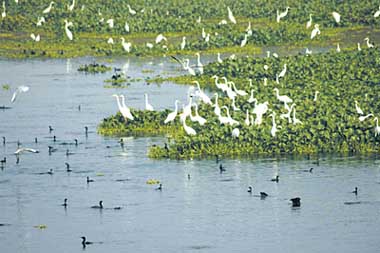 Harike wetland in Punjab’s Taran Taran District is the second largest bird sanctuary of India. It’s home to rare varieties of avifauna arriving here from different parts of Europe and northern Asia for stay during a major part of the year. About 60 kilometres from Amritsar, it is one of the largest freshwater wetlands in north India and is spread over 93 square miles. Of the total expanse of the wetland area of Harike Pattan, 26 square miles is open water.
Harike Pattan presents an inspirational example of nature conservation by authorities and non-government organisations. A visit to Harike Pattan bird sanctuary showcases how the golden wealth of nature exists here in its divine glory, untainted and undisturbed. And, why there is need for it to remain like that.
A few non-government agencies have now come forward for the conservation of some precious ecologically important habitats and spread public awareness among locals here.
During autumn, spring and winter, Harike Pattan turns a shelter for hundreds of species of birds. It is strategically situated for birds migrating to and from central Asia and Siberia.
It is one of the ancient confluences where the rivers Satluj and Beas converge. It's a quite sacred place. The confluence has been developed among the world's top 10 centauries. It is one of the largest wetlands of India and for centuries it has been home to migratory birds. The people of Punjab are familiar with these birds, as they are the best friends of children.
The sanctuary came into existence with the construction of a barrage at the confluence of the river Beas and Satluj for water storage and providing irrigation and drinking water. In 1978, the Punjab government declared the water-based body a wildlife sanctuary.
Punjab Tourism News by Sikh Tourism
Thursday, August 28, 2008
Hotel Ramgarh Fort near Chandigarh has tallest Door in country
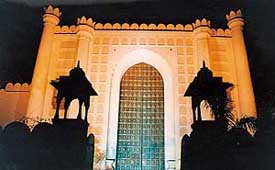
It is official. The door of the Fort at Ramgarh is the tallest door in the country higher than even the gate of Fatehpur Sikri near Agra. The latest edition of the Limca Book of Records which is the Indian equivalent to the Guinness Book of Records, lists the entry of the “tallest door” at page number 204.
The wooden door guarding the 350-year-old Ramgarh Fort near Chandigarh measures 37ft in height and 14½ ft in width.
The “Buland Darwaza” at Fatehpur Sikri stands 120 ft tall, including the steps and the constructed area but the actual door is only 23 ft. The door at the Bathinda fort in Punjab is 26 feet high.
Interestingly, the doors of forts and palaces were kept exceptionally tall in previous centuries so that the rajas sitting on elephants could enter without dismounting. Hence they were often called hathi deorhi.
The door of the fort is a replica of the original door, which was built 300 years back by the Chandel Rajput dynasty but broken during the 1857 mutiny. The replica was reconstructed in late 1980, by Kanwar Mohan Singh, a scion of the former ruling family of Ramgarh, is now a part of the premises converted into a heritage hotel. Each of its two panels weighs 21 quintals despite which, it can be easily closed and opened. About 2000 man-days were spent in putting the new door together with 343 custom-made copper plates and 343 spikes on it.
Spikes were used on the doors in olden days so that these could not be broken by an attacking army with the help of elephants banging their heads on it.
The “Buland Darwaza” at Fatehpur Sikri stands 120 ft tall, including the steps and the constructed area but the actual door is only 23 ft. The door at the Bathinda fort in Punjab is 26 feet high.
Interestingly, the doors of forts and palaces were kept exceptionally tall in previous centuries so that the rajas sitting on elephants could enter without dismounting. Hence they were often called hathi deorhi.
The door of the fort is a replica of the original door, which was built 300 years back by the Chandel Rajput dynasty but broken during the 1857 mutiny. The replica was reconstructed in late 1980, by Kanwar Mohan Singh, a scion of the former ruling family of Ramgarh, is now a part of the premises converted into a heritage hotel. Each of its two panels weighs 21 quintals despite which, it can be easily closed and opened. About 2000 man-days were spent in putting the new door together with 343 custom-made copper plates and 343 spikes on it.
Spikes were used on the doors in olden days so that these could not be broken by an attacking army with the help of elephants banging their heads on it.
Sunday, August 24, 2008
Punjabi Jutti no more a popular wear

Punjabi Jutti was known for its immaculate embroidery and varied hues which made it a popular wear for the people of the region for all types of occasions.But today it appears to be on its way out in absence of any government support and in face of fashion trends which are too fast-paced for the practitioners of this trade to keep abreast of, almost bringing down curtain on this century-old tradition.
A survey revealed that this handicraft business are fast shrinking. The Punjabi Jutti market near the Quila Mubarak in Patiala, which once enjoyed an enviable reputation for this trade, is finding the old hands there no more keen on this craft. Thousands of families involved in making these Jutti since 19th century are unable to earn enough to keep their body and soul together and are feeling compelled to bid adieu to their trade.
“The Jutti was in a great demand in early 60s and 70s, but 90 onwards, there was a decline in its popularity. Due to new trends in fashion, it was no more a daily wear. Although we tried our level best to keep pace with these trends, but due to lack of enough funds at our disposal and frequent changes in fashion, we failed to cater to the need,” revealed some of the families involved in the trade said.
Apart from this, the new taxes on the raw material like leather has further tightened the noose around this business. Earlier, there was no tax on leather, but now it has been brought under the ambit of Vat, thus leaving the makers of these Jutti with no option but to bow out. Earlier, this business was allowed some subsidies too. But now with subsidy gone and on the top of it extra levies slapped, the margins have come down drastically.Revealed the owner of Punjabi Jutti House, Jagdish Kumar, “Earlier, one shopkeeper used to have a nearly Rs 3-5 lakh turnover every year, but now it has come down by 70 pc and our commerce with various distributors from Delhi, Gurgaon and Bombay has also declined.”
‘Each one, Teach one’ - It’s learn & teach in Punjab college
One minute, they are students trying to absorb as much of the lesson as possible. The bell goes and they slip into a different role — that of teachers. In Gurdaspur’s Baba Aya Singh Riarki College for Women, ‘each one, teach one’ isn’t just a saying; it’s the college code. So, seniors teach juniors, set question papers for them, distribute answersheets and ensure that the exam goes off smoothly. Sans invigilators, mind you. For copying is unheard of in this institution established in 1967, with the aim of educating girls.
"The first time in front of a class is daunting but now I lecture confidently," says 18-year-old Harpreet Kaur, a econdyear BA student who teaches first-year students. All disputes are also resolved by the students themselves to boost their problemsolving skills.
Not just teaching, everything here is inhouse. Students cook, wash clothes and clean the campus, eliminating the need for any staff. Enter the building, and it is difficult to distinguish teacher from the taught, cook from sweeper. Clad in white salwar-kameez with heads covered in white dupattas, students rotate duties as teacher, cook and sweeper. The principal’s wife, Jagdish Kaur, oversees all kitchen activities.
"In our institution, the annual expenditure for a day scholar is Rs 800 and Rs 6,000 for a boarder," says octogenarian Swaran Singh Virk, who besides being principal is administrator, guide and mentor for students. Presently, the hostel accommodates about 2,000 students.
The college also has its own flour mill, saw mill and cane-sugar grinder, dairy farm and even a biogas plant that supplies gas to the kitchen, thereby saving at least Rs 1,000 a day. Use of solar power also helps cut their energy bill by a further Rs 10,000 per year.
The extra income goes towards educating kids who can’t afford to pay even the Rs 800 annual fee, says Virk. Though it has no affiliation, Guru Nanak Dev University has established an exam centre here and evaluates answersheets.
And though self-sufficiency is the guiding principle behind this college, the results are proof that academics aren’t neglected. The pass percentage every year is 99-100%, with almost 80% getting first division.
"The first time in front of a class is daunting but now I lecture confidently," says 18-year-old Harpreet Kaur, a econdyear BA student who teaches first-year students. All disputes are also resolved by the students themselves to boost their problemsolving skills.
Not just teaching, everything here is inhouse. Students cook, wash clothes and clean the campus, eliminating the need for any staff. Enter the building, and it is difficult to distinguish teacher from the taught, cook from sweeper. Clad in white salwar-kameez with heads covered in white dupattas, students rotate duties as teacher, cook and sweeper. The principal’s wife, Jagdish Kaur, oversees all kitchen activities.
"In our institution, the annual expenditure for a day scholar is Rs 800 and Rs 6,000 for a boarder," says octogenarian Swaran Singh Virk, who besides being principal is administrator, guide and mentor for students. Presently, the hostel accommodates about 2,000 students.
The college also has its own flour mill, saw mill and cane-sugar grinder, dairy farm and even a biogas plant that supplies gas to the kitchen, thereby saving at least Rs 1,000 a day. Use of solar power also helps cut their energy bill by a further Rs 10,000 per year.
The extra income goes towards educating kids who can’t afford to pay even the Rs 800 annual fee, says Virk. Though it has no affiliation, Guru Nanak Dev University has established an exam centre here and evaluates answersheets.
And though self-sufficiency is the guiding principle behind this college, the results are proof that academics aren’t neglected. The pass percentage every year is 99-100%, with almost 80% getting first division.
Sikh Tourism introduces Punjab Village Tour

Sikh Tourism has introduced a new travel package "Punjab Village Tour" which will take you to Sikh Cultural, Religious, Rural & Heritage life of Punjab Cities of Patiala, Amritsar, Anandpur and Chandigarh along with darshan of Golden Temple, Anandpur Sahib and Gurudwaras of Delhi.
People have visited the cities of Chandigarh, Jalandhar, Ludhiana, Patiala and Amritsar but may not have seen the actual life of a lively Punjab. For a traveler, Punjab is a wonderful tourist destination and especially if your visit a countryside place or Pind (village)is what you wish to explore on your Punjab Village Tour, spend some in a traditional Punjab village.
During this tour, a traveller will be shown the actual daily life of a villager, given homemade food, could participate in the local works like carpentary, ploughing, cow milking, clay pottery, etc. They could also see the work being done on handicrafts like Phulkari, utensil making, wood work, etc.
For more details, see at http://www.sikhtourism.com/punjab-village-tour.htm
Wednesday, August 13, 2008
Punjab heritage edifices being restored to boost tourism
The land of five rivers Punjab is also known for its grand history existing in its centuries-old forts, fortresses and Serais or, traditional lodgings created by the erstwhile rulers of Punjab. It's been always felt that these historical buildings hold a huge tourist potential, provided they are properly maintained. The Punjab Government, in collaboration with the United Nations' World Tourism Organization (UNWTO), has taken up the task of restoring heritage buildings for the promotion of tourism in the State. The restoration is being done by the UNWTO giving utmost attention to keep the original beauty of the heritage buildings intact.
For this mega restoration project, UNWTO has prepared a Master Plan and the Punjab and Central government are providing the resources including skilled artisans. The 'Shahi Samadhian' or the royal cremation ground is one of the many historical places in Punjab that are presently undergoing a makeover. Restoration work is also being done at the memorial or Samadhi of Baba Alla Singh, the founder of Patiala city.
The Punjab government wants to promote Amritsar, Kapurthala and Patiala as tourist destinations. The State government had earlier tied up with the UN World Tourism Organization to jointly promote Punjab as a global destination for religio-heritage tourism.
"The Golden temple is not the only Sikh heritage site in Punjab. There are lots of other places, which are overlooked. Lots of pilgrims go to Anandpur Sahib, which is wonderful. But just down the road is Kiratpur, which is very important from the point of view of Sikh heritage. It's a lovely little town having lots of lovely Gurudwaras, heritage gardens and so on. These places are missed since they are not publicized well enough. We want to emphasise those," an official observed.
If the princely state of Patiala boasts of the Sheesh Mehal and Bahadurgarh Fort, Kapurthala city is proud of its Jalaukhand fort. Besides majestic forts and palaces, there are historical Sikh shrines and edifices that attract tourists.
The Punjab government has listed 65 heritage sites to refurbish, out of which 12 are to be restored by the end of this year.

For this mega restoration project, UNWTO has prepared a Master Plan and the Punjab and Central government are providing the resources including skilled artisans. The 'Shahi Samadhian' or the royal cremation ground is one of the many historical places in Punjab that are presently undergoing a makeover. Restoration work is also being done at the memorial or Samadhi of Baba Alla Singh, the founder of Patiala city.
The Punjab government wants to promote Amritsar, Kapurthala and Patiala as tourist destinations. The State government had earlier tied up with the UN World Tourism Organization to jointly promote Punjab as a global destination for religio-heritage tourism.
"The Golden temple is not the only Sikh heritage site in Punjab. There are lots of other places, which are overlooked. Lots of pilgrims go to Anandpur Sahib, which is wonderful. But just down the road is Kiratpur, which is very important from the point of view of Sikh heritage. It's a lovely little town having lots of lovely Gurudwaras, heritage gardens and so on. These places are missed since they are not publicized well enough. We want to emphasise those," an official observed.
If the princely state of Patiala boasts of the Sheesh Mehal and Bahadurgarh Fort, Kapurthala city is proud of its Jalaukhand fort. Besides majestic forts and palaces, there are historical Sikh shrines and edifices that attract tourists.
The Punjab government has listed 65 heritage sites to refurbish, out of which 12 are to be restored by the end of this year.
Monday, July 28, 2008
Indian government approves helipad near Sikh shrine Hemkund Sahib
The central government has approved 'in principle' the setting up of a helipad near the famous Sikh shrine of Hemkund Sahib located in Uttarakhand, Punjab Chief Minister Parkash Singh Badal said.
The move follows a proposal to this effect by the Punjab government to the central government. Badal, who on Friday met Union Minister of State for Forests and wildlife S. Reghupathy in New Delhi, said that the minister had 'in principle' agreed to the setting up of a helipad near the shrine subject to clearances from concerned departments, including the Uttarakhand government.
The holy and historic shrine of Hemkunt Sahib is associated with the 10th Sikh guru, Gobind Singh, and is located in the Garhwal Himalayas near the Hindu shrine of Badrinath. It is said that the guru had worshipped at this shrine for a long time in the 17th century. Thousands of devout Sikhs and others visit the shrine every year. Reaching it means an arduous trek of over 19 km from Gobind Ghat through forests and glades, including the famous valley of flowers. The shrine route is open to the public only for a few months in the summers.
The setting up of a helipad will ensure that those who can afford the helicopter trip will be able to visit the shrine without undertaking the trek.
Badal has also sought the central government's permission for setting up an expansive and well-equipped concrete edifice to accommodate thousands of devotees who visit the shrine every year.
The Punjab government has also sought permission to reinforce the main structure of the shrine saying that the present one is unstable given the number of devotees coming there.
"The pilgrims undertake a lot of hardship to reach the shrine. It is the duty of the Punjab government to provide them with facilities there," Badal said.
The forest minister assured Badal that he would get the entire proposal examined by the Ministry of Environment and Forests for the development of infrastructure and facilities for pilgrims around the holy shrine.
Monday, June 23, 2008
Amritsar Gets Tourism Police
Amritsar seeks to safeguard the interests of tourists who fall victim to crooks and cons. AMRITSAR – One of the most popular tourist cities in Punjab his hoping a 30-person special police squad will help protect its 100,000 daily visitors. Tourists have often fallen victims to cheats and touts and ended up losing their belongings and valuables, said Punjab Chief Minister Parkash Singh Badal as he announced the formation of the Amritsar Tourism Police by the city’s district police department.
The tourism police will be stationed around-the-clock at Darbar Sahib, the airport, the railway station, bus stands and the Attari border.
"Special training has been imparted to these officers in tourism management,” said Kunwar Vijay Pratap Singh, Amritsar’s senior superintendent of police, who will personally supervise the 30-member squad led by Inspector Ramnish Kumar.
“The main objective of the Amritsar Tourism Police will be to prevent harassment of tourists by touts, help in getting transport and lodging at appropriate rates and help avoid hassles at the railway station, airport, bus terminals and other important tourist locations."
At a joint news conference Thursday, the Punjab chief minister lauded the effort of the local police in protecting the city’s burgeoning tourist population.
"Amritsar is emerging as a sikh tourism hub, one of the most visited places in the world with about one lakh (100,000) visitors who come here every day,” Parkash Singh said. “They include a large number of devotees from other sates in India as well as from the foreign countries.”
It is not known whether tourists in need will be able to recognize a tourism-police officer from a regular officer.
The tourism police will be stationed around-the-clock at Darbar Sahib, the airport, the railway station, bus stands and the Attari border.
"Special training has been imparted to these officers in tourism management,” said Kunwar Vijay Pratap Singh, Amritsar’s senior superintendent of police, who will personally supervise the 30-member squad led by Inspector Ramnish Kumar.
“The main objective of the Amritsar Tourism Police will be to prevent harassment of tourists by touts, help in getting transport and lodging at appropriate rates and help avoid hassles at the railway station, airport, bus terminals and other important tourist locations."
At a joint news conference Thursday, the Punjab chief minister lauded the effort of the local police in protecting the city’s burgeoning tourist population.
"Amritsar is emerging as a sikh tourism hub, one of the most visited places in the world with about one lakh (100,000) visitors who come here every day,” Parkash Singh said. “They include a large number of devotees from other sates in India as well as from the foreign countries.”
It is not known whether tourists in need will be able to recognize a tourism-police officer from a regular officer.


Friday, June 13, 2008
See Punjab and Gurudwaras through www.sikhtourism.com
Even though officially there is a Tourism department under Punjab Government but there is nobody to answer your enquiry about any place, gurudwara or tour. In this regard, there is a private travel website www.sikhtourism.com launched by one web professional Parvinder Singh. Sikhtourism website offers all the tours on Sikh Pilgrimage, Gurudwara Yatra and Punjab Tours. Even though, Parvinder Singh is also wokring for money, still he offers all the information, tour details, train & flight timings and other required details without expecting the business.For more information on this website, see at www.sikhtourism.com
Punjab never presented itself as a tourist destination
The Punjab government has joined hands with United Nations World Tourism Organisation (UNWTO) to promote tourism in the state. The 10 member team, having know-how in human resources, environment, marketing, infrastructure planning, business consultant is being led by UNWTO leader, Richard Batchelor. Batchelor is busy preparing a master plan to build the brand image of Punjab as tourist destination since last February. He has worked in West Bengal and Orissa to tourism the states’ tourism. Batchelor, who has 27 years of experience in the tourism sector, told how Punjab could become an attraction for the international tourists .
“The tourism ministry has never presented Punjab as a tourist destination. No wonder, there are hardly tourist information centres. Moreover, there is a dire need of having tour guides. Public-private partnership (PPP) can play a big role in improving the infrastructure. Besides pumping in the money, there is need for proper marketing the state”, he added.
Richard said Punjab should be presented as a religio-heritage and farm tourism destination. According to him, heritage towns like Patiala, Kapurthala, Bathinda, Sultanpur Lodhi, Anandpur Sahib, Fatehgarh Sahib, Kiratpur Sahib with magnificent architectural value, rich heritage and fascinating history had ‘amazing’ but unexploited tourism potential.
Even though officially there is a Tourism department under Punjab Government but there is nobody to answer your enquiry about any place, gurudwara or tour. In this regard, there is a private travel website www.sikhtourism.com launched by one web professional Parvinder Singh. Sikhtourism website offers all the tours on Sikh Pilgrimage, Gurudwara Yatra and Punjab Tours. Even though, Parvinder Singh is also wokring for money, still he offers all the information, tour details, train & flight timings and other required details without expecting the business.
For more information on this website, see at www.sikhtourism.com
“The tourism ministry has never presented Punjab as a tourist destination. No wonder, there are hardly tourist information centres. Moreover, there is a dire need of having tour guides. Public-private partnership (PPP) can play a big role in improving the infrastructure. Besides pumping in the money, there is need for proper marketing the state”, he added.
Richard said Punjab should be presented as a religio-heritage and farm tourism destination. According to him, heritage towns like Patiala, Kapurthala, Bathinda, Sultanpur Lodhi, Anandpur Sahib, Fatehgarh Sahib, Kiratpur Sahib with magnificent architectural value, rich heritage and fascinating history had ‘amazing’ but unexploited tourism potential.
Even though officially there is a Tourism department under Punjab Government but there is nobody to answer your enquiry about any place, gurudwara or tour. In this regard, there is a private travel website www.sikhtourism.com launched by one web professional Parvinder Singh. Sikhtourism website offers all the tours on Sikh Pilgrimage, Gurudwara Yatra and Punjab Tours. Even though, Parvinder Singh is also wokring for money, still he offers all the information, tour details, train & flight timings and other required details without expecting the business.
For more information on this website, see at www.sikhtourism.com
Monday, November 19, 2007
Polution Threat to Harimandir Sahib
The Shiromani Gurdwara Prabandhak Committee (SGPC) should take immediate steps to control pollution around Golden Temple. SGPC should frame a policy within the next three or four months for initiating steps for controlling pollution caused by the use of fire crackers in the temple complex. Authorities concerned should also take preventive measure to control pollution created by the small scale industries situated around the temple.
Sri Harimandir Sahib, also known as Sri Darbar Sahib or Golden Temple is named after Hari(God) the temple of God. The Sikhs all over the world, daily wish to pay visit to Amritsar and to pay obeisance at Sri Harimandir Sahib in their Ardas.
It is pertinent to mention here that the Punjab Pollution Control Board, which had been monitoring the environment around the Golden Temple, found high levels of harmful nitrous oxide and sulphur dioxide in the ambient air. The experts had also cautioned that fireworks release these gases which could react with marble leading to its corrosion and blackening. The miniature paintings and gold plating are also under threat from the harmful gases, the experts added. The recent study was an eye opener that fireworks at the shrine complex could cause such a damaging effect on the Harmandir Sahib.
It was difficult to change the 400-year old tradition but the SGPC authorities should discuss the issue so that the shrine could be saved from being damaged.
Sri Harimandir Sahib, also known as Sri Darbar Sahib or Golden Temple is named after Hari(God) the temple of God. The Sikhs all over the world, daily wish to pay visit to Amritsar and to pay obeisance at Sri Harimandir Sahib in their Ardas.
It is pertinent to mention here that the Punjab Pollution Control Board, which had been monitoring the environment around the Golden Temple, found high levels of harmful nitrous oxide and sulphur dioxide in the ambient air. The experts had also cautioned that fireworks release these gases which could react with marble leading to its corrosion and blackening. The miniature paintings and gold plating are also under threat from the harmful gases, the experts added. The recent study was an eye opener that fireworks at the shrine complex could cause such a damaging effect on the Harmandir Sahib.
It was difficult to change the 400-year old tradition but the SGPC authorities should discuss the issue so that the shrine could be saved from being damaged.
Wednesday, November 14, 2007
Punjabi wedding hot on India and Punjab tourism
India's only planned city, Chandigarh, has been projected as an ideal destination to get married at the ongoing World Travel Mart (WTM) in London to cash in on the craze for the big, fat Punjabi wedding among non-resident Indians (NRIs) and foreigners.
"Chandigarh tourism has decided to adopt more novel and innovative measures like wedding tourism to promote the city as the tourism hub of north India," the city's Home and Tourism Secretary Krishna Mohan, who is visiting the WTM, said Wednesday.
He said wedding ceremonies could be facilitated in collaboration with hotels and resorts in and around the city.
"Indian weddings are occasions to behold and Chandigarh is particularly known for its glamorous and graceful wedding ceremonies. European visitors in particular relish such occasions and Chandigarh tourism is in the process of facilitating more foreign visitors for these ceremonies," the home secretary said.
Mohan said that Chandigarh was not only a tourist attraction for its architectural beauty but also for medical and sports tourism. The city had excellent facilities for golf, tennis, cricket and other sports.
Chandigarh has recently been placed on the tentative list of World heritage sites by UNESCO, becoming the first Indian city to make it to the list.
For any enquiry for Punjabi Theme wedding, ask at http://www.sikhtourism.com/enquiry.htm
"Chandigarh tourism has decided to adopt more novel and innovative measures like wedding tourism to promote the city as the tourism hub of north India," the city's Home and Tourism Secretary Krishna Mohan, who is visiting the WTM, said Wednesday.
He said wedding ceremonies could be facilitated in collaboration with hotels and resorts in and around the city.
"Indian weddings are occasions to behold and Chandigarh is particularly known for its glamorous and graceful wedding ceremonies. European visitors in particular relish such occasions and Chandigarh tourism is in the process of facilitating more foreign visitors for these ceremonies," the home secretary said.
Mohan said that Chandigarh was not only a tourist attraction for its architectural beauty but also for medical and sports tourism. The city had excellent facilities for golf, tennis, cricket and other sports.
Chandigarh has recently been placed on the tentative list of World heritage sites by UNESCO, becoming the first Indian city to make it to the list.
For any enquiry for Punjabi Theme wedding, ask at http://www.sikhtourism.com/enquiry.htm
Why do Sikhs celebrate Diwali ?
The festival of Divali is an important event for most of the South Asian community. For Hindus it represents the day when the mythological god King Rama came back to his capital after 12 years of exile. Rama’s subjects were so happy to see him that they lit divas (lamps) and set of firecrackers in honour of the event. Even today Hindus celebrate this event with great happiness and joy. On this day they worship fire and the goddess of wealth, Lakshmi.
Why do Sikhs celebrate Divali? When we look into most history books, we can gather that the reason that Divali is celebrated is as follows :
After the torture and death of Sri Guru Arjun Dev Ji, by the order of Jahangir (the emperor of India at the time), the Mogul administration started to become uneasy due to the sudden popularity of Sikhism. Chandu, an advisor of Jahangir, was the one who had suggested the torture of Sri Guru Arjun Dev Ji. He suddenly felt threatened at the popularity of the Sikhs and decided to advise the king to get rid of the next Guru of the Sikhs as well. Jahangir decided that this was a good idea and summoned Guru Hargobind Ji to his court where he had Guru Ji imprisoned in Gwalior fort where 52 innocent Hindu Princes were imprisoned as well. During imprisonment, the Guru noticed that all the princes were depressed and forlorn with their treatment in the jail and were in very unhealthy conditions. The Guru helped the princes regain their health and taught them spiritually. When the Guru was granted freedom, he refused to leave until he had gained the release of the 52 Hindu kings too. The emperor then said that all those princes that could hold on the Guru’s clothes would be liberated as well. Guru Ji had a special cloak made which had 52 strings sewed on it and each prince held on to a string. Thus all prisoners were freed. It was in this respect that Guru Hargobind became known as “Bandi Chor” or the Releaser of Prisoners. When Guru Ji reached Amritsar, it was Divali day and Sikhs celebrated the homecoming of the Guru by lighting diyas. To this day Sikhs celebrate Divali and in honour of Guru Hargobind Ji and his return.
So, it’s really quite simple. Sikhs do have their own Diwali … right? Maybe not.
Why do Sikhs celebrate Divali? When we look into most history books, we can gather that the reason that Divali is celebrated is as follows :
After the torture and death of Sri Guru Arjun Dev Ji, by the order of Jahangir (the emperor of India at the time), the Mogul administration started to become uneasy due to the sudden popularity of Sikhism. Chandu, an advisor of Jahangir, was the one who had suggested the torture of Sri Guru Arjun Dev Ji. He suddenly felt threatened at the popularity of the Sikhs and decided to advise the king to get rid of the next Guru of the Sikhs as well. Jahangir decided that this was a good idea and summoned Guru Hargobind Ji to his court where he had Guru Ji imprisoned in Gwalior fort where 52 innocent Hindu Princes were imprisoned as well. During imprisonment, the Guru noticed that all the princes were depressed and forlorn with their treatment in the jail and were in very unhealthy conditions. The Guru helped the princes regain their health and taught them spiritually. When the Guru was granted freedom, he refused to leave until he had gained the release of the 52 Hindu kings too. The emperor then said that all those princes that could hold on the Guru’s clothes would be liberated as well. Guru Ji had a special cloak made which had 52 strings sewed on it and each prince held on to a string. Thus all prisoners were freed. It was in this respect that Guru Hargobind became known as “Bandi Chor” or the Releaser of Prisoners. When Guru Ji reached Amritsar, it was Divali day and Sikhs celebrated the homecoming of the Guru by lighting diyas. To this day Sikhs celebrate Divali and in honour of Guru Hargobind Ji and his return.
So, it’s really quite simple. Sikhs do have their own Diwali … right? Maybe not.
Subscribe to:
Posts (Atom)