Showing posts with label sikh gurus. Show all posts

Thursday, March 19, 2009

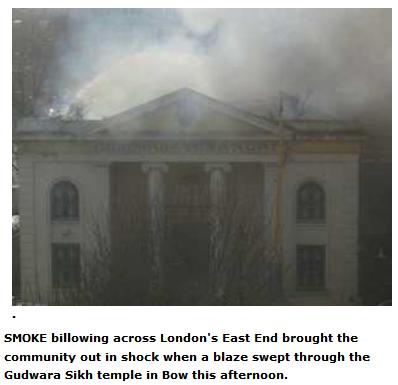
London gurdwara gutted in racist attack

One of London's most important gurdwara, housing priceless religious books, has been gutted in a suspected racist attack in Britain, a news report said on Tuesday. Eye-witnesses on Tuesday said that a man, who entered the Gurdwara Sikh Sangat in East London, managed to escape just before flames were first seen. A group of women, who had spotted the intruder, tried to put out the raging flames in one of the holiest parts of the gurdwara, which was built at Bow in 1979.

Most of the gurdwara's roof collapsed and worshipers fear all but one of its eight holy books have been destroyed, the ‘Evening Standard’ newspaper said on Tuesday. Eye-witnesses described the suspected arsonist as being black or mixed-race. A worshiper said he had noticed racist graffiti on one of the gurdwara's outer walls in the past few weeks.

A criminal investigation has been launched and police and fire investigators are treating the blaze as suspicious. The building, which dates back to 1854 was formerly a synagogue and before that a chapel. The London Fire Brigade confirmed that 75 per cent of the building and the roof had been damaged by the fire.

"Police are treating this incident as suspicious," a Metropolitan police spokesman was quoted as saying by the British daily.

More than 50 firefighters battled the flame for almost eight hours after being called just after 2 p.m. yesterday, the report said.

Sunday, March 08, 2009

Golden Temple Amritsar's Darshani Deori to be renovated by Experts

Shiromani Gurdwara Parbandhak Committee (SGPC) has agreed to get the renovation of Darshani Deori, which leads to sanctum sanctorum of the Golden Temple, done by experts with the support of the district administration.

Earlier, the SGPC had stopped the renovation of the deori being done through kar seva when The Tribune highlighted the use of gaudy colours, crude workmanship and sub-standard material in March last year. Talking to The Tribune, Deputy Commissioner KS Pannu said more than Rs 56 lakh would be spent on the conservation of the deori as per the tradition.

The experts have recommended that the cement plaster on the deori be removed with wooden hammer. The restoration work would include waterproofing of the terrace. Wooden boarding, wooden panels in niches above the entrance to a private TV channel office would be removed.Conservation of wall paintings on the cornice and bracket area of the deori by cleaning of painted surface has been recommended.

A team comprising Maninder Gill, Ajaydeep Jamwal and Tushar Chakarvarty has been entrusted with the restoration of Baba Atal and other heritage buildings. Meanwhile, in another major decision, the priceless frescoes that adorn the inner walls of the gurdwara would be recreated in its original designs and pattern. The entire cost of the project is estimated at Rs 1.20 crore and would be met through donations and contributions from other sources.

Sunday, November 02, 2008

Rousing welcome to Guru Granth Sahib at Sachkhand Hazur Sahib

The Guru Granth Sahib was given a rousing welcome at the Takhat Sachkhand Shri Hazur Abchalnagar Sahib Gurdwara, Nanded on Thursday as it arrived for consecration in connection with 300 years of its elevation as the eternal Guru of Sikhs.

This Gurdwara is central to the ‘Gurta Gaddi’ celebrations, for which pilgrims from across the world have been registering since October 27 when the festivities actually began. Prime Minister Manmohan Singh was among the devotees who paid their obeisance at the Gurdwara on Thursday.

Music and colours that are typical of Sikhs characterised the Gurta Gaddi ‘nagar keertan’ procession, which started in the morning from the Nagina Ghat Sahib Gurdwara on the banks of Godavari. The Guru Granth Sahib was carried in a ‘palki’ (palanquin) placed in a specially designed vehicle.

The Gurta Gaddi diwas was one of the two most important days, the other being the observance of Guru Gobind Singh’s ‘parlok gaman’ (departure for the heavenly abode) on November 3.

The straight road between the two Gurdwaras was choked with an estimated 3 lakh pilgrims. The bright saffron and blue of the Nihangs and Akalis and the white clothes worn by other devotees lent colour to the procession. Devotees danced ‘bhangda’ to the robust beats of the dhol and the band and sang devotional songs. Some marched to Sikh martial tunes. The bhangda dance provided for the folk component, while the keertans gave a touch of devotion. The martial slogan Bole so nihal ... Sat Sri Akal and the tune Deh Shiva bar mohe ehe shubh karman te kabhon na taraun ... ” complemented the other kinds of music.

The sacred Guru Granth Sahib was received at the main gate amid the ‘shastra salami’ of swords. The process of enthroning it included its ‘prakash’ and application of sandalwood tilak and aarti. The Guru Granth Sahib was opened at random for the ‘hukamnama’ or the edict for the day.

Monday, October 13, 2008

Gurudwara Saragarhi memorial, a tribute to the gallantry of 21 Sikh soldiers

Every year Sikhs in Punjab's Ferozepur district mark Saragarhi Day to remember the unparalleled valour, demonstrated by 21 Sikh soldiers on September 12, 1897 while participating in the battle of Saragarhi against a 10,000 strong enemy force.The Sikh soldiers of the 4th Battalion (then 36th Sikhs) of the Sikh Regiment of British India were sent to defend Fort Lockhart at Saragarhi post, in North West Frontier Province (now in Pakistan). Some 10,000 tribesmen had attacked the Saragarhi post. The battle lasted over six hours and one by one the defenders kept falling while trying to protect their post. But they did not surrender. The day of battle is observed each year as `Saragarhi Day' to mark the event.

The Gurudwara, named Saragarhi memorial, in Ferozepur today stands as a protected monument and is a tribute to those Sikh soldiers who sacrificed their lives. The memorial gurudwara, surrounded by half-a-dozen small and big cannons with names of the 21 brave soldiers inscribed on its walls, was built by the army with stones from the Saragarhi post. It was declared open in 1904 by Sir Charles Revz. Saragarhi memorial is an inspiration to many a symbol of courage and bravery.

Captain Sadhu Singh of the Sikh Regiment, said:" About 110-years-ago, on 12th of September, 1897 a war was fought, in which 21 brave soldiers were martyred while fighting under the leadership of Hawaldar Ishwar Singh at Saragarhi Post. In memory of those martyrs, we celebrate this day every year. Whatever our ancestors have given us in legacy is for the making of our nation and community proud. "

On the occasion of 110th anniversary of the Saragarhi Day a cross-country run was held in which hundreds of civilians as well as army personnel participated. After covering a distance of nine miles on the Faridkot-Ferozepur Road, the run culminated at the Saragarhi Memorial Gurudwara. The Sikh Regiment organized cross-country and cycle rally with the support of the state government to inspire youth and instill a spirit of sacrifice for the motherland in them.

Ferozepur city in South-west Punjab is on the sensitive border with Pakistan that has witnessed three wars. The border village lacks medical facilities and to make the Saragarhi Day a memorable one the army also organized a free medical camp .

Each year by observing the Saragarhi Day, the spirit and inspiration is kept alive from generation to generation.

Monday, October 06, 2008

Sikh guru in Heroes of Environment list

Heaping praises on environmentalist Baba Balbir Singh Seechewal for launching a campaign to clean up the polluted 'Kali Bein' in Punjab, Time magazine has profiled the Sikh sect leader as one of the 30 'Heroes of Environment' selected from across the globe. Describing Seechewal as the man 'who set out to clean up this mess', the magazine lauded him for mobilising people to launch a movement that taught the people why they should clean the 'Kali Bein'.

'We have proved that it is possible to restore our rivers to a pristine condition if we all come together,' Seechewal told the Time magazine.

'It is time to do that on a bigger scale,' he said.

'Kali Bein', the 160-km-long river in Hoshiarpur district in Punjab, was reduced to a filthy drain into which people from more than six towns and 40 villages emptied their waste, leaving neighbouring farmlands parched. The river was revived a couple of years back after Seechewal and his followers took up the cause and raised funds to clean the river, which is now a favourite picnic spot.

Sikhs believe that Guru Nanak Dev attained enlightenment after taking a dip in 'Kali Bein' 500 years back before founding Sikhism.

'In 2000, Seechawal, a Sikh holy man, set out to clean up the mess in the river. The scale of the task was gigantic-volunteers cleared the entire riverbed of water hyacinth and silt, and built riverbanks and roads alongside the river,' the magazine wrote.

Seechawal launched a public-awareness campaign asking the villagers to dispose of their sewage elsewhere and some people revived traditional methods of waste disposal and treatment.

'A government order to divert water from a nearby canal was eventually obtained. As the riverbed was cleared, natural springs revived and the river began to fill up. Since then trees have been planted along its banks and fishing has been preserve biodiversity,' the magazine said.

Friday, September 12, 2008

Hazur Sahib, Nanded readies to receive Sikh multitudes for Gurta Gaddi Diwas

Hazur Sahib
Hazoor Sahib
With the historic day less than two months away, massive preparations are afoot to prepare for the multitudes of Sikhs that would throng this historic religious town for the Tercentenary celebrations of the Guruship of Guru Granth Sahib. Situated on the banks of the Godavri, the fourth Takht of the Sikh nation at Nanded is gradually sprucing up to welcome the sea of humanity that is likely to reach here on or around October 20 to celebrate a concept unparalleled in the religious history of the world. All religions have their scriptures and all are sacred. The Sikhs are blessed with having their Guru – their World Teacher – with them all the time. Sikhs will celebrate the unique bestowing of Guruship to the Word of the Gurus by the tenth Master, Guru Gobind Singh, in 1708 at Nanded, before he passed away.

Around the main Gurdwara and the famous Baba Nidhan Singh Langar, cleanliness on the streets and in the inn and the outer façade of the Langar Sahib is noteworthy.

Though there is no sarovar surrounding the main Gurdwara like Darbar Sahib Amritsar, the new periphery of Huzur Sahib now has some architectural resemblance to the housing complexes that surround the Golden Temple. The resplendence and glory of the neighbourhood is gradually getting a sheen though the roads and other infrastructure leading to the main sanctum sanctorum, the road outside the railway station and the airport are still to be completed. The Takht management committee expects all preparations to be finalized before the D-day.

In twenty villages around Nanded, tents with basic hygiene and sanitation facilities are being set up by the Maharashtra government. The Takht Management Committee has also built more inns and rest houses for visitors from India and foreign countries.

Around the historic Gurdwaras of Nanded, all efforts and activities are by the Sikh Sangat. The organization of tours and travels is also by the Sangat themselves. Except for some roads which are being rebuilt, which in any case is the responsibility of the state, there was no visible evidence of any significant expenditure by the state or central government, the SGPC or DSGMC. As in the case of all centennial celebrations of the Sikhs over the last decade, as far as these organizations are concerned, Sikhs largely feel there will be some uproar for a week and then it will be back to mundane basics.

Kar Sewa Babas are making military style preparations for the Langar as they expect to feed lakhs of people during the course of the celebrations. Langar utensils are being purchased in thousands and a fleet of volunteers are being pressed into the gigantic task.

Guru Gobind Singh’s clarion call in 1708 was unmistakably clear: “Agya Payi Akal Ki, Tabe Chalayo Panth, Sabh Sikhan Ko Hukam Hai, Guru Manyo Granth.” – By order of the God Almighty, the Khalsa Panth was formed. It is a diktat to all Sikhs that henceforth your Guru is only the Granth. This call and its deeper meaning have rattled many religious thinkers and the concept of the Word as the Guru has still to be appropriately explained by the Sikhs to the world.

The last days of the tenth Master, Guru Gobind Singh was spent at Nanded and when the Sikh world would celebrate the Guruship of Guru Granth Sahib, it would also recall the anniversary of the passing away of the Tenth Master. The consciousness of the Sikh people to revere the teachings as enshrined in Guru Granth Sahib and which teachings are not only that of the Sikh Gurus but also other religious leaders of the Bhakti movement and even before has brought them in confrontation with many pseudo-movements within the Sikh fold and outside it -which do not adhere to this doctrine. Forces attempting to undermine the distinctness of Guru Granth Sahib abound but a very large section of the community continues to have abiding faith in it as a living embodiment.

As usual and as expected, I could not find any literature in Punjabi, English, Hindi or the local language Marathi inviting the Sangat to the Takht or telling the visitor the significance of the coming occasion. The 300-Saal–Guru de Naal T shirt was omnipresent everywhere in the stalls all along the promenade outside the Takht.

Abchalnagar incorporates the land of some forty villages donated two centuries ago by the Nizam of Hyderabad -Sikhandar Jah to the Sikhs in gratitude of the support given to him by the Sikh armies of Maharaja Ranjit Singh. Very little of that land remains as a majority of it has been frittered away by a lackadaisical and short-sighted management committee whose custodians have invariably failed to protect the interests of the Sikhs under temptation of pecuniary gain and leadership and political pressure of the local government.

The destruction of the heritage sites-the Ramgharia Bunga and the Baradari alongside the Takht Sahib Gurdwara, the need for upkeep and maintenance of all the historic Gurdwaras in around fifty kilometer radius of Takht Apchalnagar Huzur Sahib, the complete rehabilitation of those families who have been uprooted from their home and hearth to make way for expansion plans, the democratization of the management set-up of the Takht and the poverty of the local Sikhs were stark realities one finds difficult to ignore. One also hopes that with such huge focus on the celebrations, the various management committees and voluntary organizations the world over would not continue to ignore this aspect once the celebrations are over.

After 300 years with the Guru, there should be no need left for the community or any of its individuals to indulge in self-pity. The community needs to stand tall, capable and strong and be counted amongst the comity of nations. If the Sikh nation does succeed, the objective of spending millions at Nanded would have been achieved.
Tuesday, September 02, 2008

World's first Sikh University to come up at Fatehgarh Sahib in Punjab

Fatehgarh Sahib, Punjab, is a holy town for Sikhs, where two sons of the 10th Sikh Guru, Gobind Singh, attained martyrdom in the 18th century, is set to be home to the first Sikh university - the Sri Guru Granth Sahib World University.

Punjab Chief Minister Parkash Singh Badal will Monday lay the first stone of the foundation monument - the 'Minar-e-Ikonkar' (Tower of God is one) - in this historic Sikh holy town, around 60 km from Chandigarh.

The university, spread over 84 acres given by the Shiromani Gurudwara Prabandhak Committee (SGPC), is coming up in an year which also marks the 300th anniversary of the 'Gurgaddi' (installation) of the Sikh holy book, Guru Granth Sahib, at 'Harmandar Sahib', the holiest of Sikh shrines, in Amritsar. Though founded with traditional values espoused by the Sikh religion, the university will deal with contemporary issues like the authentic interpretation of Sikhism in the modern context and idiom, role of Sikhism in the making of the 21st century society and the third millennium civilization, a state government spokesman said.

It also aims at addressing contemporary problems of Sikh identity vis-a-vis forces and processes of globalisation, facts about the Sikh diaspora and role of Sikhism and global interfaith dialogue, he added.

Sikhism is one of the youngest religions in the world, founded by the first Sikh guru, Nanak Dev, in the 15th century. The Sikhs, considered one of the most progressive communities, traditionally hail from the north Indian state of Punjab.
Besides the routine courses in arts, science and other fields, the university will focus on emerging technologies such as bio-technology, nano-technology, information technology and disciplines like ecology, human rights, feminism, empowerment of the down-trodden and other related spheres.

To give the university a 21st century outlook, it is looking at multi-national companies and other international universities for tie-ups. The spokesman said that arrangements will be made with foreign universities to enable scholars of Sri Guru Granth Sahib World University to be sent abroad as part of the course study.

Regional and overseas extension centres of the University will be established in India, North America, Europe, Southeast Asia and other countries wherever Sikhs and Sikhism have reached.

The university authorities are also planning to rope in the Sikh diaspora in the new venture.

The university also gives the students an option to undertake advanced studies in Sikhism - its philosophy, ethics, relation with other religions, history, music, linguistics, holy shrines and historical places associated with the religion, architecture, paintings, way of life, martial arts, diaspora and role of Sikhism in the 21st century.