Tuesday, August 12, 2008

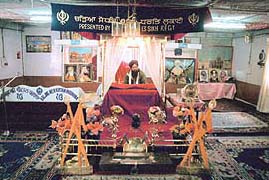
Gurudwara Nanak Shahi the main Sikh Gurudwara in Bangladesh

Gurudwara Nanak Shahi the main Sikh Gurudwara in Bangladesh, is situated on the campus of the university of dhaka near the arts faculty building. It is believed to have been built on the initiative of a Sikh priest, Almast, sent by the sixth Sikh guru, Hargobind Singh (1595-1644), during the reign of Emperor jahangir. Some others believe it was built by the ninth Sikh guru, Teg Bahadur Singh (1621-75), and that from here communication was maintained with other Sikh Gurudwaras in Bengal, Bihar and Orissa.

This shrine commemorates Guru Nanak's visit to Dacca. For some years in the recent past, the place had suffered neglect, and it was on the 2nd January 1972, after the liberation of Bangladesh, that Sri Guru Granth Sahib was installed again at the shrine. The room where the congregation met was 9 by 9 meters. Towards the left is an ancient tank, newly cleared of debris, with a baoli in its midst.

The Gurudwara was founded by a missionary sent to Bangladesh by Baba Gurditta, son of Guru Hargobing (6th Guru) within 17th century and was completed in 1830. Religious celebrations include weekly prayers every Friday. Social functions such as Baishakhi are celebrated. Old relics-an old handwritten volume of Guru Granth Sahib, a copy of the Portrait of Guru Teg Bahadur and Guru Teg Bahdur's sandals are preserved here Suitable accommodation is available for visitors.

Gurudwara Nanakshahi in Ramana behind the public library adjoining the Dacca University campus, was originally an Udasi Charan-Paduka founded by Baba Nath, successor of Bhai Almast, in memory of Guru Nanak Dev. When Guru Tegh Bahadur was at Dacca during the late 1660s, Bhai Nattha was the Udasi mahant and Baba Bulaki Das the Guru's masand here. On the eve of the Partition, possession and priesthood was the subject of court cases between Baba Tribeni Das and another claimant Gobind Das, and later between Tribeni Das and one Manik Lal. Ultimately Tribeni Das was adjudged the lawful guardian of the Gurudwara, but in the wake of the Partition, he left for India never to return. A Sikh, Swarn Singh looked after this place in his absence. After the creation of Bangladesh after Indo-Pak war, a Sikh deputation was sent from Takht Sri Patna Sahib to Dacca. With the help of Sikh soldiers the members of the deputation led by Captain Bhag Singh of Calcutta recovered possession of the Gurudwara, cleaned it and held a congregation in it on 2nd January, 1972. Even Sayyad Nazar-ul-Islam, then acting President of Bangla Desh attended the congregation and gave assurance about the safety and reconstruction of this and the other Gurudwaras.

The Gurudwara is open to all, irrespective of race, religion, caste or sex. The place of prayer is known as 'darbar sahib' and has entrances on all sides, unlike other places of worship. At the northern end of the prayer hall a copy of the holy book of the Sikhs, the granth shahib, is kept on a wooden platform. A pair of wooden sandals, believed to belong to Guru Teg Bahadur Singh, has been preserved in a glass box just under the Granth Sahib.

The daily religious rites at the Gurudwara include reading from the Granth Sahib and recital of prayers. Every Friday a weekly assembly is held from 11 am to 1 pm. The chief granthi reads from the Granth Sahib. kirtan and prayers continue for over two hours. The prayer service ends with the distribution of food. There are also arrangements to distribute food in the morning. Sikhs regard this as a way of enhancing understanding among people. A weekly congregation is held by it in Gurdwara Nanakshahi, on every Friday, which is attended mostly by the devoted staff of the Indian High Commission, some Sikh devotees from the neighbouring lands and some devout Hindu residents of Dhaka.

There are also about eight or nine smaller Gurudwaras in different parts of Bangladesh. The Bangladesh Gurudwara Management Committee runs the affairs of these Gurudwaras with financial support from the devotees, foreign visitors, donors and grants from the Bangladesh government.

Sunday, August 10, 2008

Gurudwara Pathar Sahib, a major tourist attraction in Leh Ladakh

Built by Buddhist Lamas nearly five centuries ago to commemorate the visit of Guru Nanak, the founder of the Sikh religion, to Ladakh, the Gurudwara Pathar Sahib is visited by Hindu and Sikh devotees, besides tourists. Although the Ladakh's culture and religion is deeply influenced by Buddhism, the existence of Gurudwara 'Pathar Sahib' adds to the region's religious history and identity.


Legend has it that many centuries ago a demon had terrorised the people of Leh. Baba Guru Nanak, who visited the region around 1516 A.D, came to know about the problem and decided to bless them with his sermons. Locals welcomed him with open arms. His growing popularity angered the demon and in a fit of rage, he decided to kill Guru Nanak with sa large boulder. The boulder, however, turned into wax as soon as it touched Guru Nanak.


"Thinking the Sikh Guru must have got killed by the boulder, the demon appeared only to be shocked to find Guru Nanak Dev meditating. He pushed the boulder with his right foot, but as it had already melted into wax, his foot got embedded in it. Realising, Guru's enormous powers, the demon fell at his feet and sought forgiveness," said Rajender Singh, the caretaker of the gurudwara. Since then, resident Lamas revere the boulder and offer prayers to it. In 1948, the Gurudwara Pathar Sahib's maintenance was taken over by the Army.


The region has a sizeable Sikh population and devotees visit the site to have their wishes fulfilled.


"By the grace of God, my wish has been fulfilled. My younger brother, whose wish has also been fulfilled, has helped me take part in the `Akhand Path', a continuous reading of Guru Granth Sahib (the religious textbook of Sikhs). We have a great belief in Gurudwara Pathar Sahib," said Harjinder Singh, a devotee from Punjab.


Organize your Gurudwara Tours through
www.sikhtourism.com

Sikh athletes to don turbans at Olympic Games

Some Canadians might not agree with the notion of altering or adding to the national team marching uniform for an Olympic opening ceremonies. Yet after listening to Canadian field hockey player Ravi Kahlon's eloquent explanation, you at least understand the reasoning why he and three fellow Indo-Canadian players will wear turbans when marching into the opening ceremonies of the 2008 Summer Games on Friday.


The four players - Victoria's Kahlon, Bindi Kullar of North Delta, Gabbar Singh of Surrey and Ranjeev Deol of Mississauga, Ont. - don't wear turbans in everyday life and don't ever intend to. So why now, on this mammoth stage, with the world watching?


A turban is a Sikh religious symbol and in no way an Indian national symbol. Kahlon said as a Canadian he would never wear any symbol of Indian nationhood during the Olympics or at any international competition. This is no different than wearing a cross on your chest or a Jewish yarmulke during the opening ceremonies, which nobody would have any problem with," said Kahlon, an RBC mortgage specialist, and outstanding forward appearing in his second Olympic Games.


sikh news by sikhtourism

Friday, August 08, 2008

Delhi Gurudwaras build ramps, wheel in faithful

Delhi ramps are with a difference. They will not see style statements being made on them but will see the differently abled devout go right up to the threshold of the Granth Sahib. Stairs at places of worship are a problem for the elderly and the differently abled. Keeping this in mind, the Delhi Shiromani Gurudwara Prabandhak Committee (DSGPC) has begun a drive to make Delhi Gurudwaras easily accessible to all.

While the government is still planning to make offices and public places differently abled-friendly, the DSGPC has completed renovations on a second Gurudwara in the city. After Gurudwara Bangla Sahib, Nanak Piao in Azadpur has completed the construction of access ramps. Alongside the staircase, these green-carpeted ramps will help the wheelchair-bound and those who can’t climb steps.

With constant complaints coming in from devotees at Bangla Sahib, the authorities finally decided to take concrete steps. “A place of worship is for everyone and it is our responsibility to ensure that no one is denied the opportunity to visit the gurudwara. We did notice that a large number of the elderly and the differently-abled had to stop coming just because they couldn’t climb stairs. Besides constructing ramps, we have also made provisions for wheelchairs,” a Sewadar said.

Ever since the ramps were put in place, a number of devotees have been coming in wheelchairs. They are comfortably wheeled up by their family members.

Wednesday, July 30, 2008

Ishmeet Singh is no more .....

The budding career of talented singer Ishmeet Singh was cut short when he died in a tragic accident in the Maldives on July 29.

Barely 20 years old, Ishmeet charmed audiences with his smile, and his terrific voice, when he won the Star Voice of India contest in November last year.

The news of Voice of India 2007 winner Ishmeet Singh's tragic death was greeted with shock and disbelief on Wednesday.

The music industry also could not get over the fact that the budding singer was no more. The Ludhiana-based singer was on a promotional tour to promote a music label with which he had signed a contract when he met with the fatal accident.

Ishmeet will be greatly missed by everyone.

Monday, July 28, 2008

Indian government approves helipad near Sikh shrine Hemkund Sahib

The central government has approved 'in principle' the setting up of a helipad near the famous Sikh shrine of Hemkund Sahib located in Uttarakhand, Punjab Chief Minister Parkash Singh Badal said.

The move follows a proposal to this effect by the Punjab government to the central government. Badal, who on Friday met Union Minister of State for Forests and wildlife S. Reghupathy in New Delhi, said that the minister had 'in principle' agreed to the setting up of a helipad near the shrine subject to clearances from concerned departments, including the Uttarakhand government.

The holy and historic shrine of Hemkunt Sahib is associated with the 10th Sikh guru, Gobind Singh, and is located in the Garhwal Himalayas near the Hindu shrine of Badrinath. It is said that the guru had worshipped at this shrine for a long time in the 17th century. Thousands of devout Sikhs and others visit the shrine every year. Reaching it means an arduous trek of over 19 km from Gobind Ghat through forests and glades, including the famous valley of flowers. The shrine route is open to the public only for a few months in the summers.

The setting up of a helipad will ensure that those who can afford the helicopter trip will be able to visit the shrine without undertaking the trek.

Badal has also sought the central government's permission for setting up an expansive and well-equipped concrete edifice to accommodate thousands of devotees who visit the shrine every year.

The Punjab government has also sought permission to reinforce the main structure of the shrine saying that the present one is unstable given the number of devotees coming there.

"The pilgrims undertake a lot of hardship to reach the shrine. It is the duty of the Punjab government to provide them with facilities there," Badal said.

The forest minister assured Badal that he would get the entire proposal examined by the Ministry of Environment and Forests for the development of infrastructure and facilities for pilgrims around the holy shrine.

Thursday, July 17, 2008

Sikh tourism can help Pak earn 500 mln dlrs

By promoting Sikh tourism and allowing Sikh tourists to land directly at the Lahore Airport, Pakistan can earn up to 500 million dollars per year, a visiting editor of a local paper in Amritsar, India, said in Lahore.

He said that around 20,000 Sikh pilgrims visited Pakistan each year to participate in four major religious events, but if Sikh tourism was promoted, the number could reach up to five lakh.

He said that if the Lahore Airport were opened for Sikhs, about half a million Sikhs would visit Pakistan every year. The Pakistan government was considering increasing the number of Sikh events in a year from four to nine, Brar said and added that the decision would enable thousands of Sikhs to visit Pakistan every month.

Baljit Singh Brar, the editor of daily 'Aj Di Awaaz' and monthly 'Punjab Times', is in Pakistan to visit Sikh religious sites, reported the Daily Times.

The Lahore Airport was better compared to the Amritsar Airport, Brar said and added that it would be beneficial to Sikh traders, who otherwise had to land at Delhi airport, which was quite a distance from Amritsar.

The Indo-Pak visa treaty, which restricts the issuance of tourist visas for travel between the countries, should be amended, he said an added that tourist visas should be given to applicants on a war footing basis in order to promote Sikh tourism in Pakistan.

Sunday, July 06, 2008

Ishnaan Therapy (Cold Shower)

"Go for it! When the cold water hits the surface of your skin (which has four layers) all the blood from way deep inside your body rushes to the surface in self-defense, vastly improving your circulation on the spot. This is called Hydrotherapy. It strengthens your entire nervous system. People pay huge sums of money for what is now called "Hydrothermal therapy" when in reality all you need is cold water!

But first, before you get wet, massage your body all over with a little oil. Oil is more easily absorbed by the skin when it is mixed with water--and you won't be greasy afterwards. Almond oil is highly recommended since the almond contains so many minerals, and it nourishes the body through the pores of the skin.

Go in and out of the water four times, constantly massaging your body until the water no longer feels cold. Be sure not to miss the area under your arms, which is where the parasympathetic and sympathetic nervous systems meet. You can even stand on one foot and massage the top of it with the other foot. Women, be sure to massage your breasts."

Above Information From the Book:The Flow of Eternal Power by Shakti Parwha Kaur Khalsa

Your first victory of the day! You will probably become very holy the moment the cold water hits your body, because it is likely you will shout, "Oh my God!" You might try exclaiming "Wahe Guru" ("Wow, God is Great!") or "Ang Sang Wahe Guru" ("God lives in every limb of my being.") Remembering God is always a blessing.

Dry off briskly with a rough towel till the body really shines; put on loose, comfortable exercise clothing, and you're ready to do your sadhana, your personal daily spiritual practice. God bless you, you're bound to have a wonderful day!

Exceptions for women: Don't take cold showers during your monthly period and No cold showers after the seventh month of pregnancy; take lukewarm, body temperature showers instead.

The Flow of Eternal Power by Shakti Parwha Kaur Khalsa "When we do ice-cold water massage, not only do we open up the capillaries, but when they return to normal, that blood goes back to the organs."

Saturday, June 28, 2008

Guru Granth Sahib Ji to be translated into 13 languages

The Guru Granth Sahib Seva Mission has taken it upon itself to translate Guru Granth Sahib into 13 prominent Indian languages so that people across the country can follow the path shown by the Gurus. The translation and publication of the granth is being undertaken so that the translated versions are ready for publication and distribution on the eve of the of 300 years of installation of the holy book as the Guru of the Sikhs in 2008.

Mr Gurinderpal Singh Dhanaula, chief sevadar of the mission, said many people from other parts of the country had urged them to undertake this exercise as the reach of the granth was universal and they were facing problems in reading the holy book. He said they were encouraged when the granth was successfully translated into Urdu by Baba Ravinderpal Singh of Talwandi Sabo. They then decided that they would approach prominent regional scholars to get the granth translated into 13 prominent languages.

Mr Dhanaula said the granth would be initially translated into Hindi, Assamese, Bengali, Gujarati, Marathi, Kannada, Oriya, Tamil, Telugu, Sindhi, Malayalam and Sanskrit. The next phase would be to get it translated into major foreign languages, he added. Work on the Oriya and Tamil versions was underway and was being done by Dr N.C. Panda of the Sambhalpur University and Kannan R. of the Madurai University, respectively.

Mr Dhanaula said initially they would get 5000 copies each of the granth printed in Urdu and Hindi while 1,000 copies each would be available in rest of the regional languages. Besides, they would also get 5 lakh copies of Japji Sahib published in Urdu and Hindi while 1 lakh each would be available for the people in other regional languages.

Commenting on the financial implications of such a massive project, he said offers were pouring in from various religious and social organisations across the country and abroad.

sikh Toursim News

Wednesday, June 25, 2008

Single Punjab Train Sachkhand Express to Gurudwara Hazur Sahib totally booked.

Sikh Tourism has received so many complaints from people from different parts of the India especially North India that there is just one Train from Punjab/Delhi for Hazur Sahib and is totally booked for next 60 to 90 days. There is not even a single seat available in II AC & III AC compartments. People whose relatives and friends have come from abroad are not being able to go to Hazur Sahib due to this.

As there is just one Aurangabad Airport near Nanded, which is also around 240 km away and is not feasible at all to travel to Nanded, people are seeking alternate routes with multi train change to reach Nanded.

Could we request Railway authorities and Hazur Sahib Gurudwara Prabandak Committee to look into this matter and start some temporary trains from Punjab/Delhi to Nanded so that more people could easily go to Hazur Sahib, Nanded ?

Private tech colleges in Punjab to reserve 10 percent seats for rural students

Association of Punjab State Technical Private Institutions Tuesday agreed in principle to reserve 10% of seats in their respective institutions free of cost exclusively for the rural students with first division or above from the academic session 2008-09. These institutions would impart absolute free education including the facilities of free boarding, lodging and transportation to the eligible beneficiaries.

Expressing grave concern to provide free education to the students with rural background who were deprived of the facility of basic education from the day one due to extreme poverty, Punjab CM called upon management of the private engineering colleges to come forward for this noble cause. CM also asked her to work out modalities for few Government Senior Secondary schools in the vicinity of these private engineering and technical colleges to run 10+2 classes by the management of these institutions as these were well equipped with qualified staff and infrastructure as a 'pilot project'. He said this step would certainly improve the quality of students to be admitted in these engineering colleges and the schools would act as a nursery for these institutions.

Punjab CM also emphasized the need to start evening classes in the institutions for short term courses in skill development free of cost for the benefit of rural students. He also asked the management of these institutions to start more engineering colleges especially at the block level within a radius of 25 to 30 K.M to cater to the need of technical education.

Comments : Step taken by these Private Collges is welcome and we hope that even government will also frame some policies where instead of caste/creed based reservations, reservation & help will be granted to rural and economically weak children.


Monday, June 23, 2008

Amritsar Gets Tourism Police

Amritsar seeks to safeguard the interests of tourists who fall victim to crooks and cons. AMRITSAR – One of the most popular tourist cities in Punjab his hoping a 30-person special police squad will help protect its 100,000 daily visitors. Tourists have often fallen victims to cheats and touts and ended up losing their belongings and valuables, said Punjab Chief Minister Parkash Singh Badal as he announced the formation of the Amritsar Tourism Police by the city’s district police department.

The tourism police will be stationed around-the-clock at Darbar Sahib, the airport, the railway station, bus stands and the Attari border.

"Special training has been imparted to these officers in tourism management,” said Kunwar Vijay Pratap Singh, Amritsar’s senior superintendent of police, who will personally supervise the 30-member squad led by Inspector Ramnish Kumar.

“The main objective of the Amritsar Tourism Police will be to prevent harassment of tourists by touts, help in getting transport and lodging at appropriate rates and help avoid hassles at the railway station, airport, bus terminals and other important tourist locations."

At a joint news conference Thursday, the Punjab chief minister lauded the effort of the local police in protecting the city’s burgeoning tourist population.

"Amritsar is emerging as a sikh tourism hub, one of the most visited places in the world with about one lakh (100,000) visitors who come here every day,” Parkash Singh said. “They include a large number of devotees from other sates in India as well as from the foreign countries.”

It is not known whether tourists in need will be able to recognize a tourism-police officer from a regular officer.

Friday, June 13, 2008

See Punjab and Gurudwaras through www.sikhtourism.com

Even though officially there is a Tourism department under Punjab Government but there is nobody to answer your enquiry about any place, gurudwara or tour. In this regard, there is a private travel website www.sikhtourism.com launched by one web professional Parvinder Singh. Sikhtourism website offers all the tours on Sikh Pilgrimage, Gurudwara Yatra and Punjab Tours. Even though, Parvinder Singh is also wokring for money, still he offers all the information, tour details, train & flight timings and other required details without expecting the business.For more information on this website, see at www.sikhtourism.com

Punjab never presented itself as a tourist destination

The Punjab government has joined hands with United Nations World Tourism Organisation (UNWTO) to promote tourism in the state. The 10 member team, having know-how in human resources, environment, marketing, infrastructure planning, business consultant is being led by UNWTO leader, Richard Batchelor. Batchelor is busy preparing a master plan to build the brand image of Punjab as tourist destination since last February. He has worked in West Bengal and Orissa to tourism the states’ tourism. Batchelor, who has 27 years of experience in the tourism sector, told how Punjab could become an attraction for the international tourists .

“The tourism ministry has never presented Punjab as a tourist destination. No wonder, there are hardly tourist information centres. Moreover, there is a dire need of having tour guides. Public-private partnership (PPP) can play a big role in improving the infrastructure. Besides pumping in the money, there is need for proper marketing the state”, he added.

Richard said Punjab should be presented as a religio-heritage and farm tourism destination. According to him, heritage towns like Patiala, Kapurthala, Bathinda, Sultanpur Lodhi, Anandpur Sahib, Fatehgarh Sahib, Kiratpur Sahib with magnificent architectural value, rich heritage and fascinating history had ‘amazing’ but unexploited tourism potential.


Even though officially there is a Tourism department under Punjab Government but there is nobody to answer your enquiry about any place, gurudwara or tour. In this regard, there is a private travel website www.sikhtourism.com launched by one web professional Parvinder Singh. Sikhtourism website offers all the tours on Sikh Pilgrimage, Gurudwara Yatra and Punjab Tours. Even though, Parvinder Singh is also wokring for money, still he offers all the information, tour details, train & flight timings and other required details without expecting the business.
For more information on this website, see at
www.sikhtourism.com

Tuesday, May 13, 2008

Turban clinic to tie Sikh Turban at Amritsar

There are salons to advise one about hairstyles. But what about salons on how to wear turbans? And to keep up with the latest trends? A unique salon in Amritsar has the answer to this. Called Turban Clinic, it advises Sikh youth on how to tie the perfect turban and what style will suit them. The clinic has devised as many as 40 ways of tying the turban. Patrons can pick the style that suits them the best, according to facial structure, height and nature of work. Advice is also given on which colours to use, depending on complexion. A specially-designed software, Smart Turban 1.0, is used for this. The customer’s photo is downloaded into a computer and various turban styles superimposed on the image, and selected. And if you want to learn the art of tying a turban, take the help of Turban Tutor 2.0.

The salon is the brainwave of Amritsar-based lawyer, Jaswinder Singh, to promote turban-wearing among Sikh youth. Many now prefer to shear their locks in order to look trendy. Also, those who aren’t permitted to do so, wear caps to escape the ‘tedious’ exercise of tying turbans. Singh says his service is free.

The venture has been a success, he claims, as Sikhs throng the place in the evening to take lessons. "We try and evolve new styles for everyone because the traditional three styles of tying turban of Majha, Malwa and Doaba regions, now look archaic and conservative," he says. Singh said, "The basic purpose of the clinic is to stop the youth from shearing their hair as this goes against the basic tenets of Sikhism. This is one of the most serious problems confronting Sikhism today." Singh, who is running an organisation called Akal Purakh Di Fauj (Army of the Almighty) to work for Sikh causes, says, "The turban is an integral part of the complete look of a Sikh. We’re just trying to inspire Sikhs to look smart, without relinquishing their turbans. Let them feel that their turbans only add to their looks."

Saturday, April 19, 2008

Hi-tech Sikh museum set to come up at Nanded.

Perhaps it is time for Sikh museums to spring up in many places, and the development is in keeping with the fervour of religiosity inspired largely by the Diaspora efforts and the celebrations of the Guru'ta Gaddi Diwas. Now it seems a state-of-the-art Sikh museum is set to come up at Nanded at a cost of Rs 20 crore as part of tercentenary celebrations of Gurta Gaddi Diwas.

The development has been confirmed by Nanded's Takht Sachkhand Sri Hazur Abchalnagar Sahib Gurdwara Board chairman Dr P.S. Pasricha who said latest technologies will be used in the new museum.


"Visitors will be imparted information about Sikh religion in either of four languages - Punjabi, English, Hindi and Marathi. The touch screen systems, latest gadgets, and many attractions will punctuate the over 30,000 square feet area. The museum will employ graphics and animation strategies and technology shall be put to use to pass on the message of Sikh gurus to youth, particularly those residing abroad, to save them from ever-increasing western culture influence," Pasricha, the former Maharashtra police chief, said.

The first phase of this museum-cum-art gallery would be made operational in 13,000 square feet area within next two months, while the entire project would be completed by October-end. Pasricha said approximately 11 acres of land surrounding the complex was being developed with landscaping and fountains. Fountain shows are being planned for the night to describe
Sikh religion.

Pasricha also said Godavari riverfront is being developed and construction of 100-feet roads on both sides of the river was undertaken by the board. Godavari will form an aquaduct and will provide a feeling of divinity and spirituality to all those who will enjoy the fascinating scenery of the original Godavari. Efforts were on to tap
religious tourism with construction of special NRI Yatri Niwas with luxurious rooms and suites of international standards.

Pasricha is also leading efforts to ensure that the new airport at Nanded, likely to operational from May 1, 2008, be named after Guru Gobind Singh.

Tuesday, April 15, 2008

Punjab celebrates harvest festival Baisakhi

People loaded on tractor-trolleys, trucks, buses and private vehicles headed for destinations of their choice this Sunday. It was certainly a busy day for Punjab as the state celebrated the festival of good harvest - Baisakhi. Sikh religious shrines - gurdwaras - were the main centre of attraction for most people from villages and those from towns and cities as they lined up to pray.

The holiest of Sikh shrines - Harmandir Sahib (Golden Temple) - in Amritsar got the maximum rush of the devout as people came from far and near to seek blessings for a good harvest. Roads to the Golden Temple, located in a congested area of the Sikh holy city of Amritsar, seemed clogged with people as thousands turned out since early Sunday morning to seek blessings.

The wheat fields in the state, which is known as the granary of the country, basked in the golden glory of a furious sunshine coming down on the produce. In most areas of Punjab’s 20 districts, the wheat produce is ready for harvest and farmers consider it auspicious to begin harvesting on or after Baisakhi.

“We were waiting for Baisakhi. We will commence harvesting Monday,” young farmer Harjodh Singh told IANS as he supervised his wheat fields on the outskirts of Hoshiarpur town, 140 km from Chandigarh. In some villages, people danced “Bhangra”, the traditional dance of Punjab associated with prosperity and good harvest.

Scores of people could be seen headed for gurudwara “Hariyan Belan” (green branches), 15 km from Hoshiarpur town near Chabbewal village, on tractor-trolleys and trucks. “Langars” (community kitchen), which is an essential part of Sikh religion, could be seen at all gurudwaras and along highways across the state with people squatting in rows to partake food.

It was on a Baisakhi day in 1699 that the 10th Sikh guru, Gobind Singh, founded the Khalsa panth - the essence of the present day Sikh religion - at Anandpur Sahib, 85 km from Chandigarh.
The Sikh shrine at Anandpur, famous for the birth of the Khalsa panth, saw hundreds of people turning up to pay obeisance. Social events and cultural programmes were organized at several places to mark the day across Punjab.

Sikh Tourism has started Amritsar Golden Temple and local Gurudwara Tours. It has also arranges Delhi to Amritsar and back to Delhi tour for 1 & 2 days. The tour package includes Train Ticket, Hotel Accomodation and local transport for darshan of Golden Temple, Tarn Taran Sahib - Goindwal Sahib - Sultanpur Lodhi Gurudwaras. For more details and pricing, visit at http://www.sikhtourism.com/golden-temple.htm
http://www.sikhtourism.com/goldentemple-delhi.htm

Wednesday, March 19, 2008

Hazur Sahib Yatra

Sikh Tourism is organising special Yatra for Hazur Sahib from Delhi and Mumbai. The tour starts from Delhi and Mumbai but sangat from other places can also avail the tour. The tour package includes Train Ticket, Hotel Accomodation and local car for darshan of Nanded Gurudwaras and Gurudwara Nank Jheera, Bidar.

For more details and pricing, visit at
http://www. sikhtourism.com/hazur-sahib.htm

Saturday, January 12, 2008

First Gurdwara Sahib in Poland Planned

Eastern Europe's first gurdwara :

A gurdwara, said to be the first in Eastern Europe, will come up in Warsaw, Polish capital as the authorities here have finally given their green signal.

The proposed gurdwara has been registered as a religious institution. Respecting the religious identity of the Sikh community here, the authorities have also allowed them to wear turbans and keep a kirpan.

"This is a glorious day for the Indian community in Poland," Singh Sabha chief administrative officer J.J. Singh said.

"Unlike France, where the Sikh community is facing many difficulties in maintaining its identity, the Polish authorities have given us what we had asked for. The rights of a minority community are being respected, which is most gratifying," Singh told IANS.

"Now our job is to collect funds not only in Poland but from other European countries to construct a beautiful gurdwara. Incidentally, it will be the first gurdwara in Eastern Europe," he added.

For the past three years, the Singh Sabha community organisation has been using a rented house in the Warsaw suburb of Rashyn to perform religious ceremonies. It has been bringing religious teachers and singers from the Amritsar-headquartered Shiromani Gurdwara Prabandhak Committee (SGPC), a mini parliament of the community in India, for religious activities.

In Poland, apart from a small number of Sikhs, there are 1,200 Sindhis who too have faith in the teachings of Guru Nanak, the founder of Sikhism, and the Guru Granth Sahib, the holy scriptures.

Janusz Krzyzowski, president of the India-Polish Cultural Committee, said: "This was a long cherished demand which has been accepted very gracefully by a largely Catholic country. In the era of globalisation people everywhere should have the right to practise their religion."